


Welcome to Scenes With Simon. A monthly newsletter about many things. This month is about algorithms, boredom, AI coding, seriousness, and aesthetics in the 21st century.
In December and January, while in South Africa, I drove a lot. I enjoyed it, not just for the beautiful scenery, but because it also forced me to put my phone down.
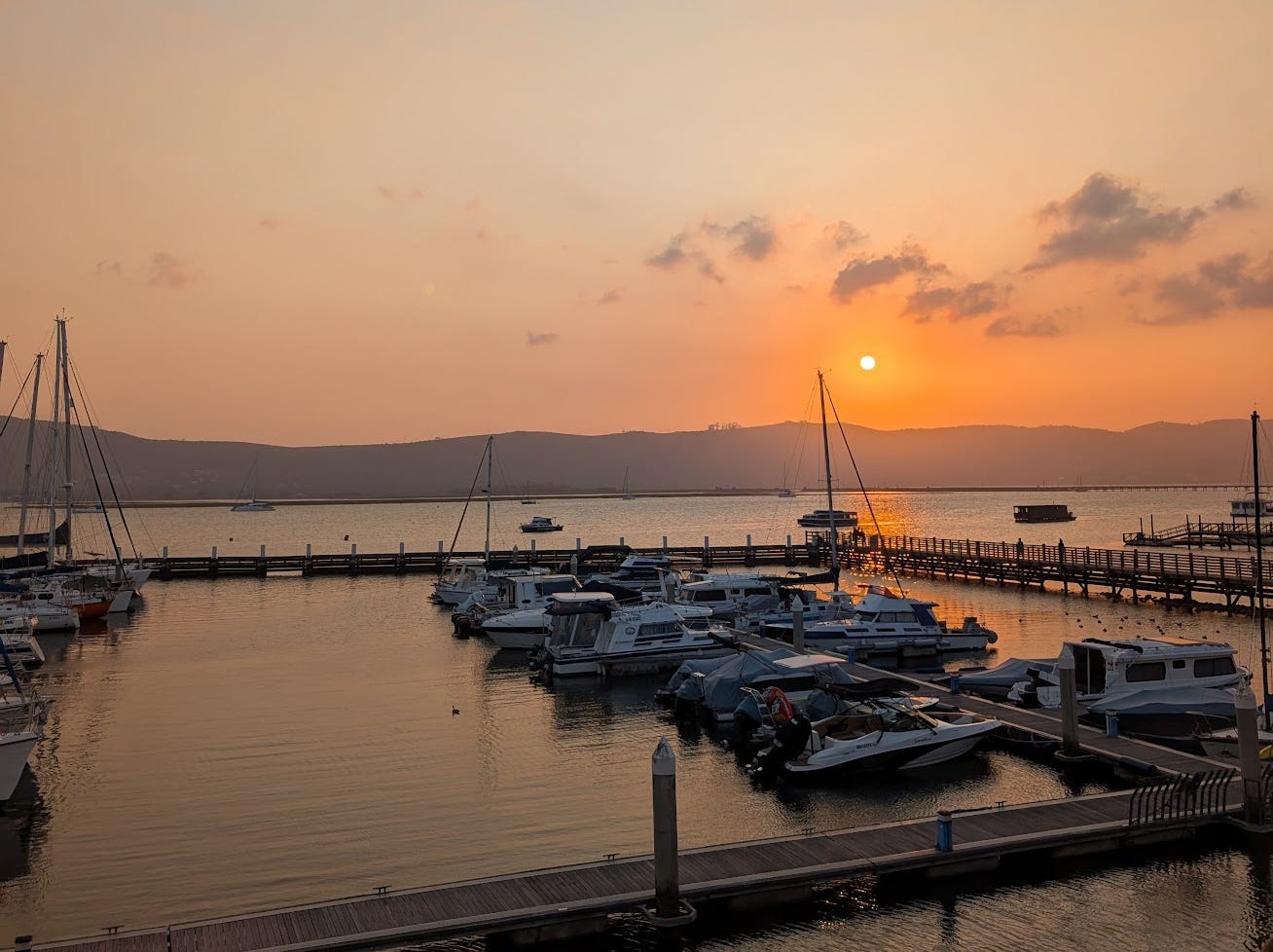
I don’t drive regularly anymore. Living in a walkable city in the USA, you rarely do. I love walking and taking public transit. But, when I lived in South Africa, there would be a few multi-hour drives in the year, going to seaside towns or in-land to the countryside. On those drives, I did some of my best and favourite thinking. New ideas, philosophies, personal breakthroughs, and adventures in imagination.
And so, on these long drives again over the holidays, I enjoyed the scenery and the wandering of my own mind. While I appreciate the venue it created for thinking, it made me realise again just how much time we’ve lost to filling it with cheap information. Many of us want to avoid doomscrolling and slop to get back what we regard as “productive” time. We see that as: going to exercise more, reading over short-form video, spending time with friends and family, working on that side project, etc.
But, the tension in this, is that we chastise ourself when we fall back into the aglo-slop traps. “Oh no, I scrolled TikTok again for an hour.”
I feel that the antithesis to being one-shotted by algorithms isn’t productivity, but boredom. Productivity is also a race against time. Hitting my mid-30s, you do exercises like: “If it takes me 2 years to write a novel, how many books could I ever write in my life?” Avoiding slop/algorithms is about wanting your time back. Productivity is equally not always the answer (note: it’s not saying one shouldn’t strive to be productive, it’s about what’s regarded as the antidote).
The answer is to create unguided time in your life. Time where you are actively bored, again. Time where you can’t do much else but let yourself wander into your surroundings. Go for a walk. Talk to a neighbour. Look at stuff. Like, really, look at it. Enjoy interruptions. Play more with the kids and the pets.
Anu recently wrote about what it felt like to not post for a bit and many of her conclusions feel familiar:
Boredom asserts itself more, and more pleasantly. You’re reminded that silence has its own texture. There’s more time to think about what you actually want, not what plays well.
These periods can be created by small tricks. At dinner parties, I’ve asked people and they shared theirs: uninstalling apps, deleting social media, putting timers on apps, turning off all notifications, using greyscale, putting your phone in another room (never on you, in your house), turning off autoplay videos, using “bricks”, going back to dumb phones, not sleeping next to your phone, etc.
It works, but this all feels like solving the supply side of the problem: you’re trying to reduce the amount of available cheap information in your life. But, we can also look at it from the demand-side, never wanting or being able to pick up your phone at all.
This is a long drive. And in what ways can we create more “long drives” in our life, again? To me, it’s turning back to a more physical prime life. To many, this comes naturally, but I grew up with nothing more than a desire to be online. The more online I could be, the more I learned, the more I connected with people, and the more I grew. My work was in my screen. My relationships was in my screen (for a while, I did long distance). My entertainment was in my screen. The world was in my screen. And during this period, I was duly rewarded for investing my world into a digital prime life. But, now, diminishing returns have swung the pendulum the other way.
And so, my goal in the past few years (mostly last year) has been to take all of these digital prime lives and see if it can be replaced by the world around me. It took attitude adjustments and leaning into new communities. Run clubs, writing salons, art gallery memberships, community events, etc. In this, I’m more present in the world around me, and when you are present in the world around you, you’re on a “long drive”. Sometimes, you can’t take out your phone, but most of the time, you don’t want to anymore.
At the end of the day, I retain a desire to stay online. To remain informed, to connect with interesting people, to share creative projects, and to keep talking. In some sense, the world needs people to show us their cool little things they’re doing. To be public about it. We need reminders that life continues anyway. If anything, I think what people crave is older social media, because those were portals into these lives.
I’ll still be productive. I’ll still make plans. I’ll still be online, but I’ll also aim to create more “long drives” in my life: towards a story, a person, a place that’s worth putting your phone down for. (I should rewatch Drive My Car).
In this monthly issue of Scenes With Simon, there’s a few essays, 5 snippets from the web, and updates on what I’ve been up to!
Why Monthly?
A Dark Forest of New Aesthetics
Claude and Generalists
Characters Taking Themselves Seriously
5 Snippets From the Web
What I’ve Been Up To
Why Monthly?
In my previous newsletter at the end of 2025, I noted that I was contemplating moving to a monthly instead of weekly format. I’ve decided to finally make this switch for a few reasons:
A consistent weekly format means I have to spend every weekend writing. And truthfully, I want more of my weekends back. Or rather, I want to choose how I spend my weekends. I want more freedom in when I write this newsletter. It will still take more time a day to write, but now I can spread this out over the course of a few weeks. In doing so, I have more freedom to write when it makes sense. If it’s a busy week, I don’t have to fit in. If I’m not busy, I can write more. An example that was tough, was, that sometimes I sit in on writing feedback groups and the weekends are a great time to read those stories. So now, my weekends became 1) long runs, 2) sometimes reading for feedback, 3) reading newsletters and what I saved to read during the week, and 4) writing this newsletter. That left much less time for simply having a regular social life too.
Slower writing. When there’s a time crunch, I don’t always get to enjoy writing. I’ve been interested in also writing about slower things. And sometimes those ideas take a few days to form and process compared to having to squeeze it out. I want to at least also include more reflections in this newsletter.
I’ll likely write a bit less now, overall, but it’s also because I want to focus my creative output into more concrete projects, rather than a newsletter. I want to do more art, writing, and vibecoding.
Let me know what you think. :)
The Dark Forest of New Aesthetics
Patrick Collison put out a grant program for people working on “new aesthetics”.
We are seeking to fund artists, architects, and designers who are consciously working to define New Aesthetics.
Hidden to some extent in this request is a question often asked of the 21st century: why do so many things look so similar for so long?
We're more than a quarter way through the new century and we can now ask: what is the aesthetic of the twenty-first century? Which are the important secessionist movements of today? Which will be the most important great works? Today, futuristic aesthetics often mean retrofuturistic aesthetics. So, what should the future actually look like?
Parts of 2006 doesn’t look so different 2026. But 1986 looks noticeably different in aesthetics to 2006.
New culture (and aesthetics) can only arrive when they are given opportunity to survive. The problem is: the web made it easier for information to travel anywhere and thus all culture competes more among itself.
Any new culture, is by definition, weird and unfamiliar. When a tribal neolithic man decides to collect a cowrie shell for the first time, it’s weird. The first women to wear a bikini, was weird. There’s a constant back and forth between general conservativism and maintenance of existing norms against novelty and strangeness. Anything new is more often than not, ostracized by the majority. To do something new is risky. It burns social capital, but when it succeeds, it generates more of it for the individual or group that tried the new thing. In the past, however, new culture only had to vie for attention from a smaller group of humans. The amount of naysayers was thus, less.
Before culture could travel to all corners of the world in an instant, culture could more easily thrive because the “group” that could shoot it down, was smaller. As humans, however, our systems are wired like immune systems: we only notice it when something goes wrong. 5 negative comments on a 100,000+ views YouTube video feels awful. A 1-star review on a book with sales of 500 copies, feels awful. So, perhaps, as a percentage of the population, naysayers had not increased, but naysayers are nominally more and they can shoot down new culture more easily across the world. A troll from New Zealand can discourage a singer from the Netherlands with one poor comment even if that singer was successful in their home country.
And so, because culture generally has less to chance to survive once it goes online, we’ve witnessed a multi-decade battle of memetics. It’s great that we can share love for the same music from different cultures in the world, but it’s also flattened culture dramatically. Big things got bigger at the same time that the long tail got longer. Most of the middle died.
It’s why US culture wars are now increasingly local politics in other countries. It’s why I also believe that Gen Z is partly “conservative”. Because the camera is always there, ready to proliferate “cringe”. There’s less freedom to truly experiment because it’s become easier to be a hater/naysayer.
The only spaces where we’ve seen new aesthetics are places where cringe is accepted as a part of the aesthetic (italian brainrot slop), corners of the web where normie acceptance isn’t desired (pockets like reddit or 4chan), and local cultures that are strong enough such that global eyes don’t understand it enough to even hate on it. For example, countries with different languages are insulated from the English speaking information Dark Forest, ready to snipe any new culture. It’s why the most exciting music of the 21st century is from places like South Africa or Brazil.
Amapiano:
Sarro:
This is true 21st century culture.
The world isn’t done yet with this smoothing out of culture, globally.
The worst part is that any aesthetic that is in public (fashion and architecture) that is supposed to be relatively permanent will be Dark Forested and NIMBY’ed out of existence before it has a change to truly flourish.
The lesson for getting new aesthetics is that new aesthetics absolutely can’t be witnessed by too many people too soon. It’s too risky. New aesthetics need to thrive out of view of the algorithm, the camera, and normiedom if it is to be given any chance of longer term survival. It needs to stay weird and new before conservative normies descend and stop it from happening.
It’s the global gossip trap (by Erik Hoel).
Which means that, with the advent of social media, and the resultant triumph of the spread of gossip over Dunbar’s number, we might have just inadvertently performed the equivalent of summoning an Elder God. The ability to organize society through raw social power given back to a species that climbed out of the trap of raw social power only by creating societies large enough they required formal organization. The gossip trap is our first Eldritch Mother, the Garrulous Gorgon With a Thousand Heads, The Beast Made Only of Sound.
Too much of the west unfortunately are scared of new cultures, new ideas, and want a return to some retro-future or neoclassical aesthetics, and they’re too online. So, yes, we need to go offline. Turn off the camera. Turn off the voluntary panopticon. Venture to the land of innovation, the new, the strange, nurture the weird, and bring back for us the new baubles of culture.
On Claude Code and Generalists
One of my favourite concepts are thresholds. I’m fascinated by the conversation around when one thing truly becomes another thing. When does a hill become a mountain? When does a lake become a sea? Sometimes things change slowly but surely until one day, it’s inevitably crossed some threshold to something new. In wanting to update and refactor old code for my art projects, I knew it was going to roughly take me a few weeks of coding to do so: most of which was going to be the effort of fitting in the code back into my brain. It’s the cost of context switching, unfortunately (and the cost of enjoying too many things).
Having written for most of the past 2.5 years, I’ve totally missed the AI coding train. And so after seeing the hype around Opus 4.5 + Claude Code, I gave it a spin. And like, many, I was utterly astonished at how well it worked. Work that could’ve taken me weeks was completed in 2 - 4 hours.
This order of magnitude improvement feels like this threshold change. It makes new things possible. I liken it to the invention of the “like” button. 1-bit communication was rarely feasible prior to the web and cheap bandwidth. Now, it feels to me that if I’m not running any AI coding agents, I’m simply missing out. It also makes the future one of generalists. Long have the idea guy been relegated to posting blogs, but now, a leader of agentic AI coding swarms (ok, yes, being dramatic here 😅).
Karpathy encapsulates what it feels like:
Fun. I didn't anticipate that with agents programming feels *more* fun because a lot of the fill in the blanks drudgery is removed and what remains is the creative part. I also feel less blocked/stuck (which is not fun) and I experience a lot more courage because there's almost always a way to work hand in hand with it to make some positive progress. I have seen the opposite sentiment from other people too; LLM coding will split up engineers based on those who primarily liked coding and those who primarily liked building.
I’ve always enjoyed coding, but if I didn’t have to code, I wouldn’t. It’s always been a means to an end for me.
With services like Ralph and Moltbot, it really feels like a new inflection point is finally here. The future is strange, but it’s here.
I love how a few years ago, none of this would’ve made sense:
Ralph is an implementation of the Geoffrey Huntley’s technique for Claude Code that enables continuous autonomous development cycles he named after Ralph Wiggum. It enables continuous autonomous development cycles where Claude Code iteratively improves your project until completion, with built-in safeguards to prevent infinite loops and API overuse.
What it’s left me with is a desire to build a habit where I can run coding experiments more regularly and fit in maybe 30min a day to review and then orchestrate/delegate again. It’s definitely doable, because what it amounts to is essentially have an army of coders at your disposal while you are doing something else (at a cost of about $200/month at max plan). Once I get this book revision done, I’m going to be coding a lot more again.
Again, via Karpathy:
TLDR Where does this leave us? LLM agent capabilities (Claude & Codex especially) have crossed some kind of threshold of coherence around December 2025 and caused a phase shift in software engineering and closely related. The intelligence part suddenly feels quite a bit ahead of all the rest of it - integrations (tools, knowledge), the necessity for new organizational workflows, processes, diffusion more generally. 2026 is going to be a high energy year as the industry metabolizes the new capability.
PS Did you see moltbook? AI agents talking among themselves?
Characters Taking Themselves Seriously
With the recent Avengers: Doomsday teasers, I noted commentary that mentioned how tonally different Thor is compared to his outing in Love and Thunder (I can’t find the commentary directly, now). The note said that in the teaser, he takes himself seriously and I thought that's a great lesson in character writing. This works for both “serious” and “comedic” characters. In making sure characters take themselves seriously, you're ensuring that they act with awareness of themselves and the story world they inhabit.
A really great comparison is the reveal of the new One Piece Live Action characters for season 2. It's goofy. It's camp as hell, but the characters act logically within their world.
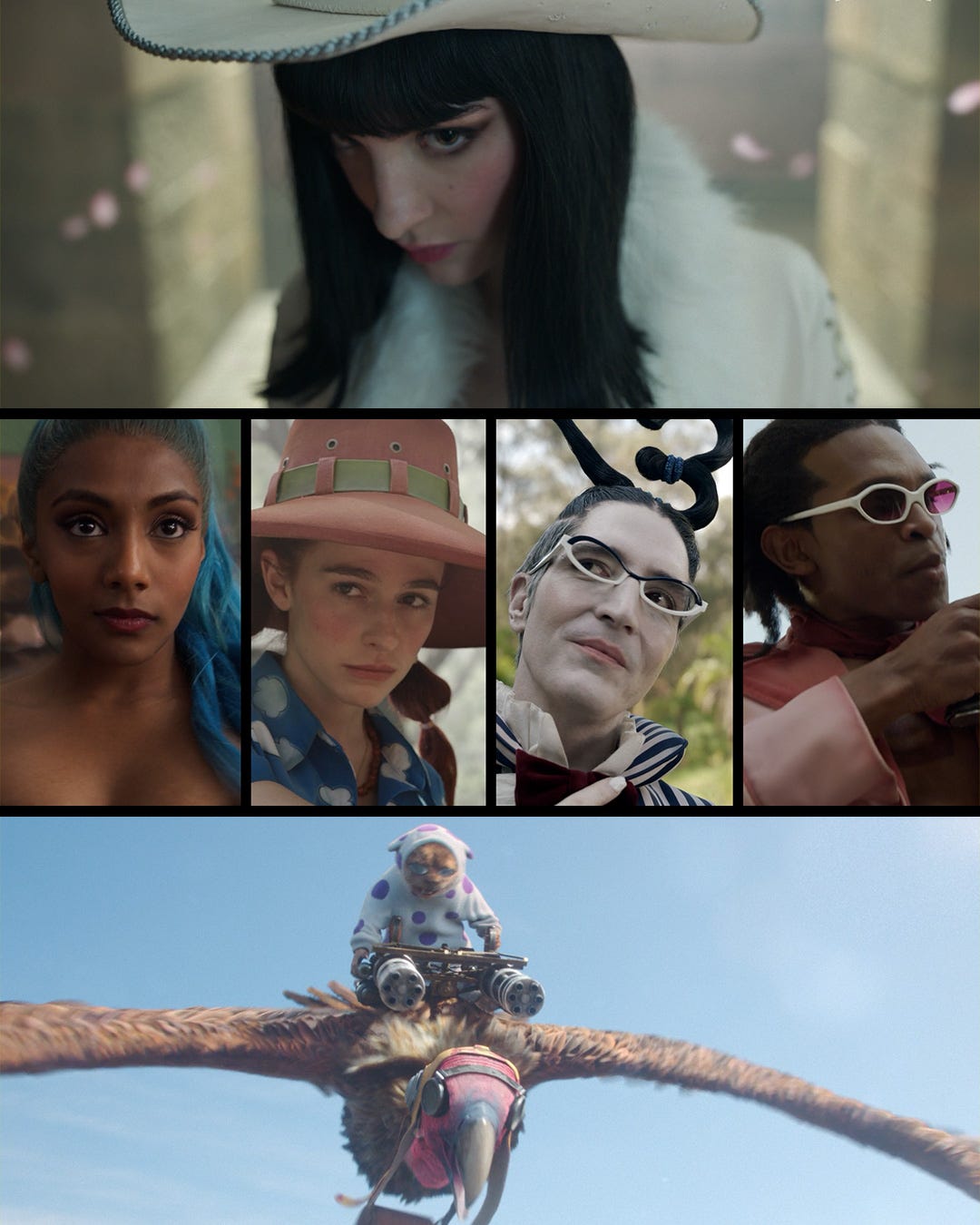
They take themselves seriously.


It's when characters are played more to the audience, where they lose their appeal. Another great example is Hitchhiker’s Guide to the Galaxy (done well). It can be weird as all hell, but at least make sure the characters take themselves seriously.
Snippets From The Web
Central Park Drivers
Blows my mind that Central Park used to have cars drive through it…

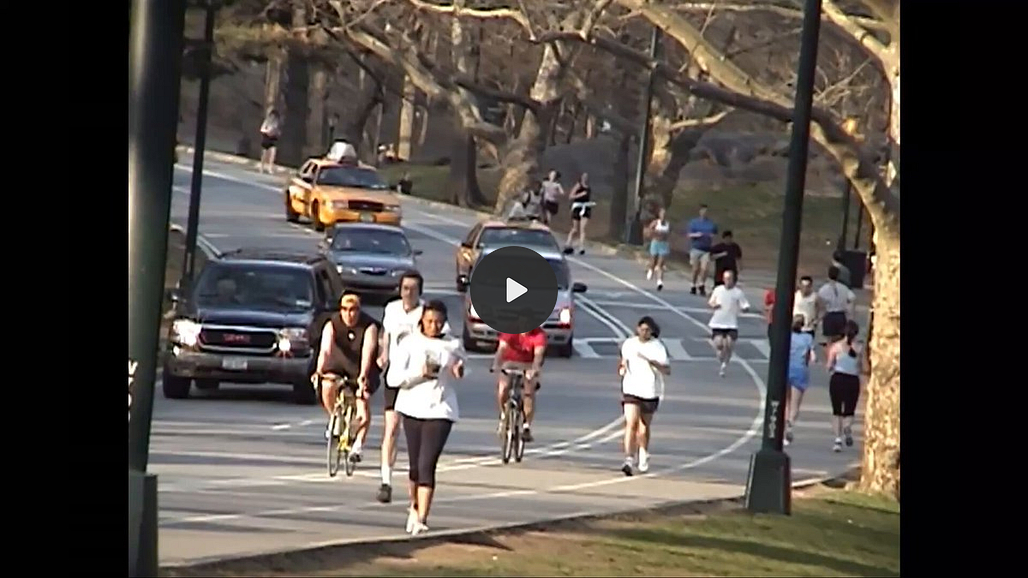
…and it was like this until recently? Heck, even I visited Central Park while it was still a thing. I don’t remember this, though.
Holidomes
Hey honey… Want to go on holiday in a warehouse that pretends it’s outside. The kids will love it. Aren’t they into that liminal thing, or what’s it called?


Small Form Factors
Huge sucker for small form factors. Do you have one of these?


Autonomous Forests


Snekdowns
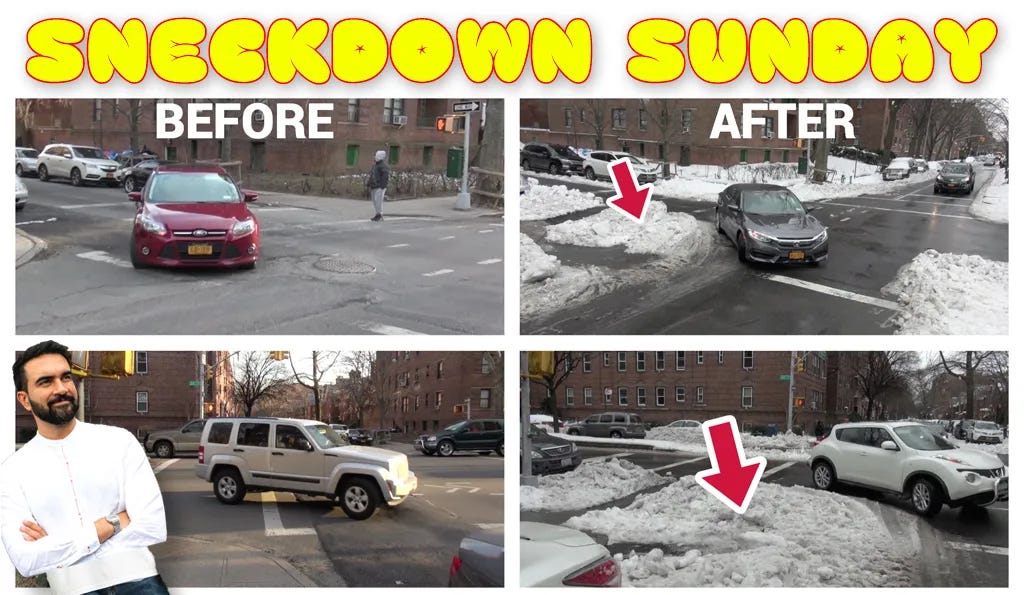
Because of the big US east coast snowstorms, a reminder of the concept of a snekdown. Snow allows urban designers to actually see what parts of the road are actually necessary.
What I’ve Been Up To
Back into a more regular routine! :)
Creating:
✍️ Writing - Novel #2
Restarted revisions on novel #2. I got really good feedback from more readers over the holidays. Much of the work since June has really been about simplifying the narrative. One interesting change is that someone mentioned that the main character is unlikeable. Which, I had to agree with… So, that’s the biggest part of this revision. Surprisingly, it’s been quite simply to make her more likeable. Maybe in the future I’ll share more about this, but the main change is to simply have the main character be more steadfast in their own beliefs. Think of Breaking Bad. If Walter White descent was immediate (from trying-his-hardest father to immediate drug kingpin), it would’ve been harder to be on his side throughout the show.
I also revised my query letter and the first five pages which I sent off to a writer conference (hoping to meet agents). It definitely felt far easier to write than the initial query letter, which to me is an indication that I’m heading in the right direction.
I do still think, however, that I’m looking at 2 - 4 months of writing to revise this book. Then, hopefully, that’s the last I’ll leave it at. 3 years of writing to get a final draft is long. Lots of lessons. From there, I’ll query like all hell to see if it lands with agents or not. If it doesn’t land, then I’m not going to go back and rewrite it. I’d rather then self-publish and move on.
👨🏻💻 Coding - Experimenting with Claude Code
See above.
🖼️ Art - Refreshes
I hope to refresh my art projects. I’ve already started with this through Claude Code. The code’s just old… That being said. I have some ideas for new projects this year… Stay tuned.
Consuming:
📺 Watching - Movies!
The Fantastic Four: First Steps - Liked it. Entertaining. But, I’m still struggling lately with the pace of superhero films. Often feels so rushed.
Taking Venice - Great documentary that goes behind the scenes on Rauschenberg (from America) winning the Venice Biennale in 1964. Enjoyed the intrigue!
Before Sunrise - Rewatched it recently. As I grow older I drift in and out as to which of the “Before” trilogy of films I like the most and it’s usually highly context dependent on where I am in my life. I still enjoy the innocence in the first one a lot.
Spectre - Can’t remember the last time I watched a Bond movie. Must’ve been Quantum of Solace. I would still say it’s not exactly my favourite type of film genre, but it was still entertaining nonetheless.
People We Meet On Vacation - Lovely, and entertaining millennial romantic drama film. Definitely felt like it was for millennials and a time where people paid young writers to travel the world and write about it… when travelling was a personality trait, and writing listicles for Buzzfeed from a coffeshop in Brooklyn was a real job.
🕹 Gaming - It Takes Two, Hades 2, Factorio: Space Age
I must say. I didn’t expect this, but Hades 2 hasn’t grabbed me as much as Hades 1 did. I think it’s simply because the novelty has worn off. But, it’s still fun to pull out for a run or two. But, have effectively shelved it for now.
Finally also got to play a bit of It Takes Two. I love the explosion of co-op games.
Yes, I’ve started playing Factorio again after the Switch 2 update with Space Age. I’m taking it slower this time, just merely enjoying it as a relaxing 20-30min every day, expanding the factory slowly but surely.
🏃 Running
I love running in winter. But, snowstorms definitely hamper it. Been a bit annoyed that I had to resort to treadmill running. :(
📚 Reading
I’ve been struggling in getting back into reading and I blame a part of it on not being able to run regularly (usually listen to audiobooks while running).
🎶 Listening
3 songs that I’ve had on repeat this month:
Joshua Lee Turner - Grand Canyon
Beautiful track (ht Niel).
Louis Prince - The Number Thirteen
Dreamy groove. Wonderful music video too.
Goth Babe - Huatulco
Seems like I’m in a dreamy groove vibe (when am I not, truly?). Great track.
That’s it for January, friends. I must say. I enjoyed writing this a lot more than doing weekly newsletters. Let me know what you think. Removing pressure on myself makes it easier to write. :)
As always. Hope you get to enjoy a lovely sunset! See you at the end of February!
Simon
Like what I write? Please consider becoming a patron below ($5/month):
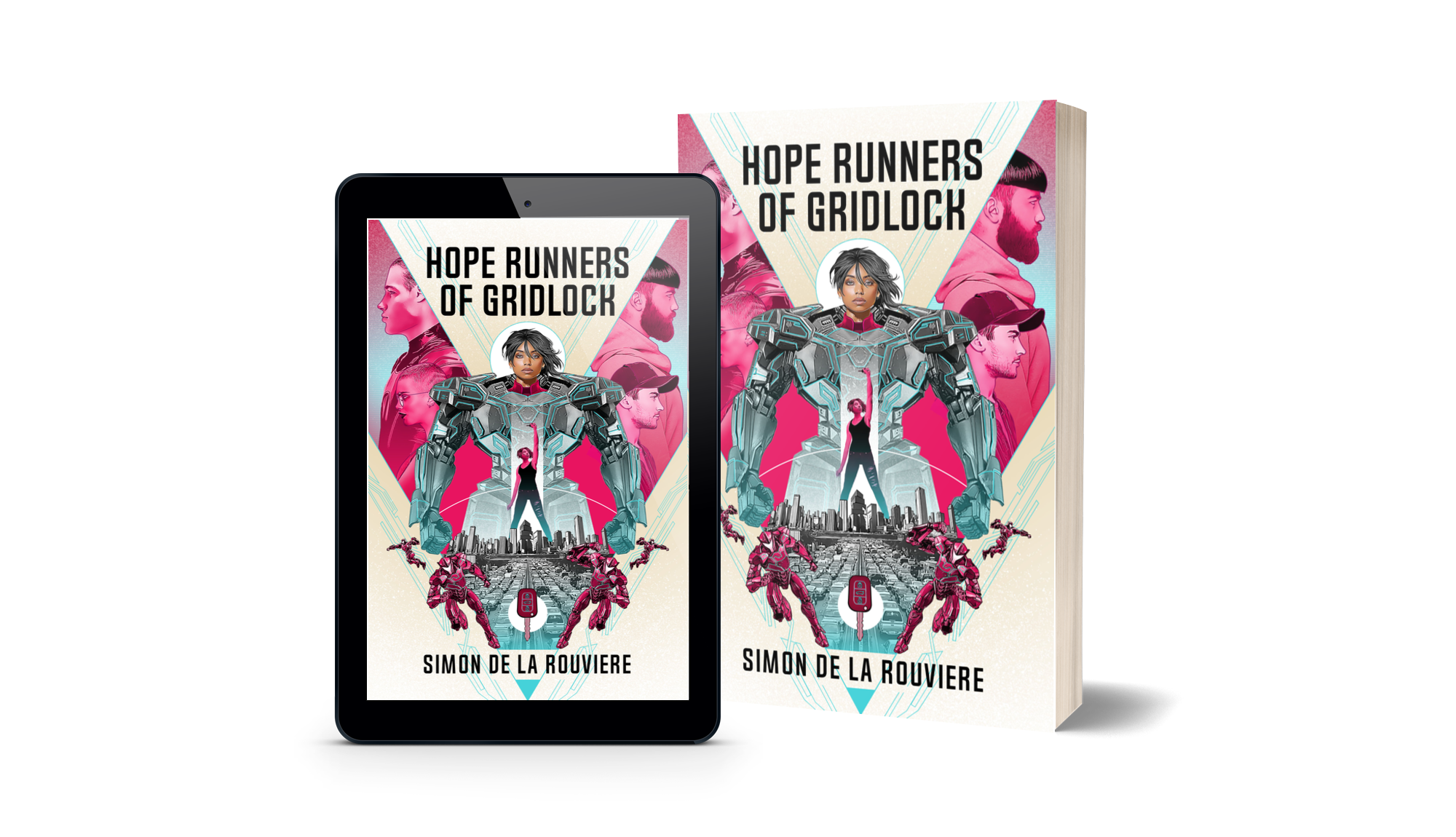
OR: Buy a copy of my self-published debut novel and leave a review!
Your argument about the Dark Forest of aesthetics is interesting.
Within crypto aesthetics, a thing I think about a lot is: Why is it that I love the retro aesthetics so much? Shouldn't it get past that.
Most of the crypto projects I see not doing a retro aesthetic just opt for boring corpoate, so that's not very cool. I don't know what the new thing would be but those are the two option.
Old, pixelated, crunchy.
Clean but dull in blacks or blues... like a consulting firm.
It all meets one of two widespread expectations.