Welcome to Scenes With Simon. A monthly newsletter about many things. This month is about hallways, the braided essay, and enfilades as experience.
The Invention of The Hallway I
There’s an interesting history to the adoption of hallways over interconnecting rooms (called, an enfilade). If you walk through a palace in Europe, you might have seen that instead of rooms connected by a hallway, they simply connected to each other. Each room was also a thoroughfare, combining destination and route.
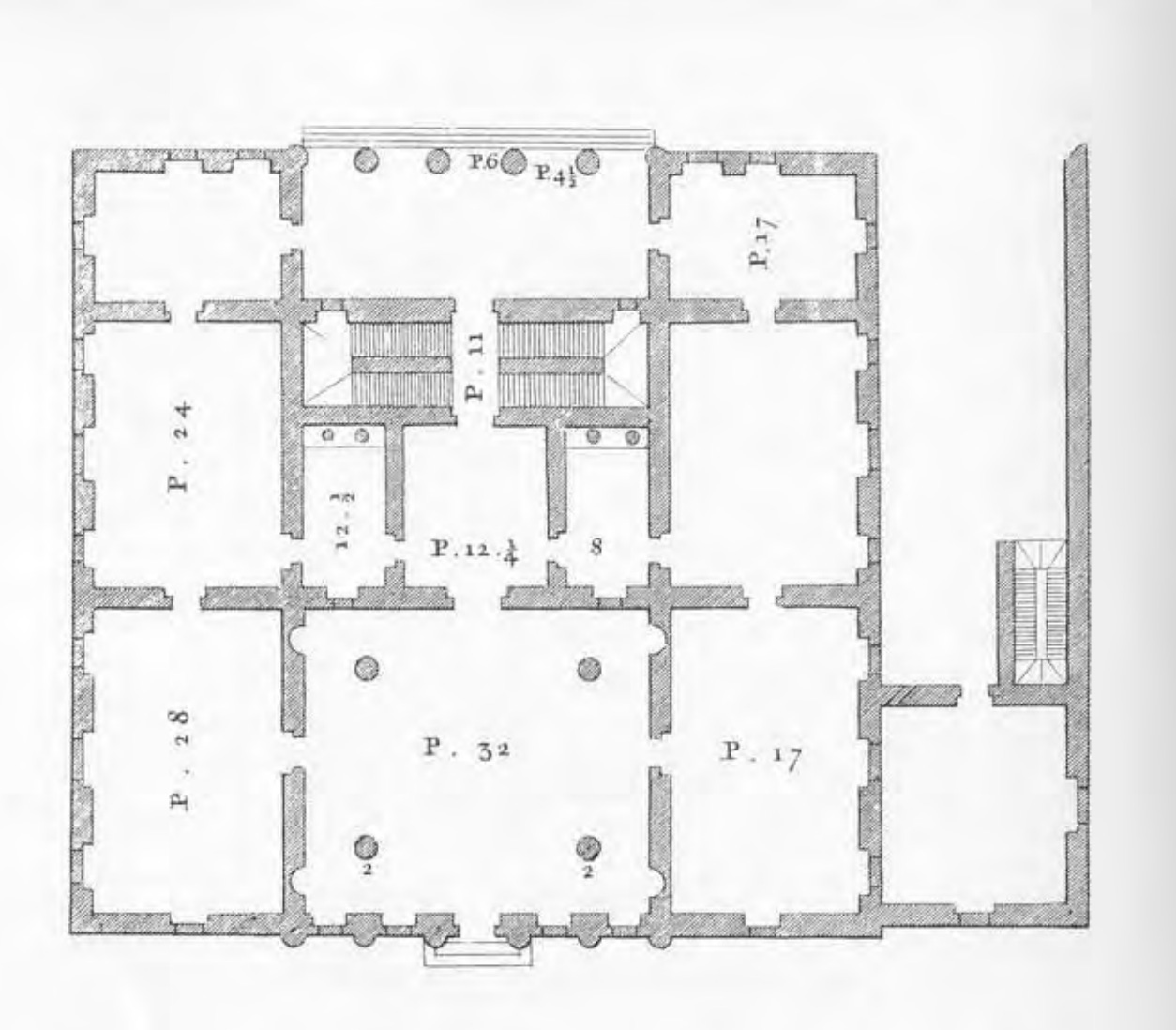
The hallway eventually came to replace the enfilade in Victorian England, driven by a need for privacy, class separation, and propriety. As Robin Evans wrote in his excellent essay on “Figures, Doors, and Passages” in 1978:
In sixteenth century Italy, a convenient room had many doors; in nineteenth century England, a convenient room had but one.
As Evans continues to write:
At one end of the spectrum of manners, Castiglione, a close friend of Raphael, recorded in the The Courtier four consecutive evening conversations supposed to have taken place during March 1507 at the Ducal Palace of Urbino. Nineteen men and four woman participated and apparently there were similar gatherings every day after supper.
Many Italian writers described the “relative frequency of recountable incident” among the court.
The Incidental Essay I
As part of my local essay writing group this month, we covered the Braided Essay, a form of essay that weaves multiple threads together. It’s not really a form I’ve encountered a lot, probably because in the era of the web, we’re stuck with this belief that we’re supposed to structure any writing in an extremely deliberate manner. Going slightly off path into a related topic isn’t desired. In some ways, an essay with only one thread feels like a Hallway. When you start, you can usually see quite far along it. And that’s the intention of most of modern essays: hold the reader’s hand and guide them along to the goal. But, sometimes, you have to quote Speed Levitch from Waking Life and tell the reader that:
On really romantic evenings of self, I go salsa dancing with my confusion.
Hold on.
The Invention of the Hallway II
The fact that continental Europe was the holdout on enfilades might describe why many of its apartment buildings (especially in old town centers), tend to be arranged around stairs.
In Europe, much more of the apartment buildings are arranged in a way where the stairs are the “hallway”. There’s no grand thoroughfare on each floor. Instead, you have multiple stairs serving many floors. This means that apartments often have access to windows on either side of it (eg, facing the street and a courtyard).
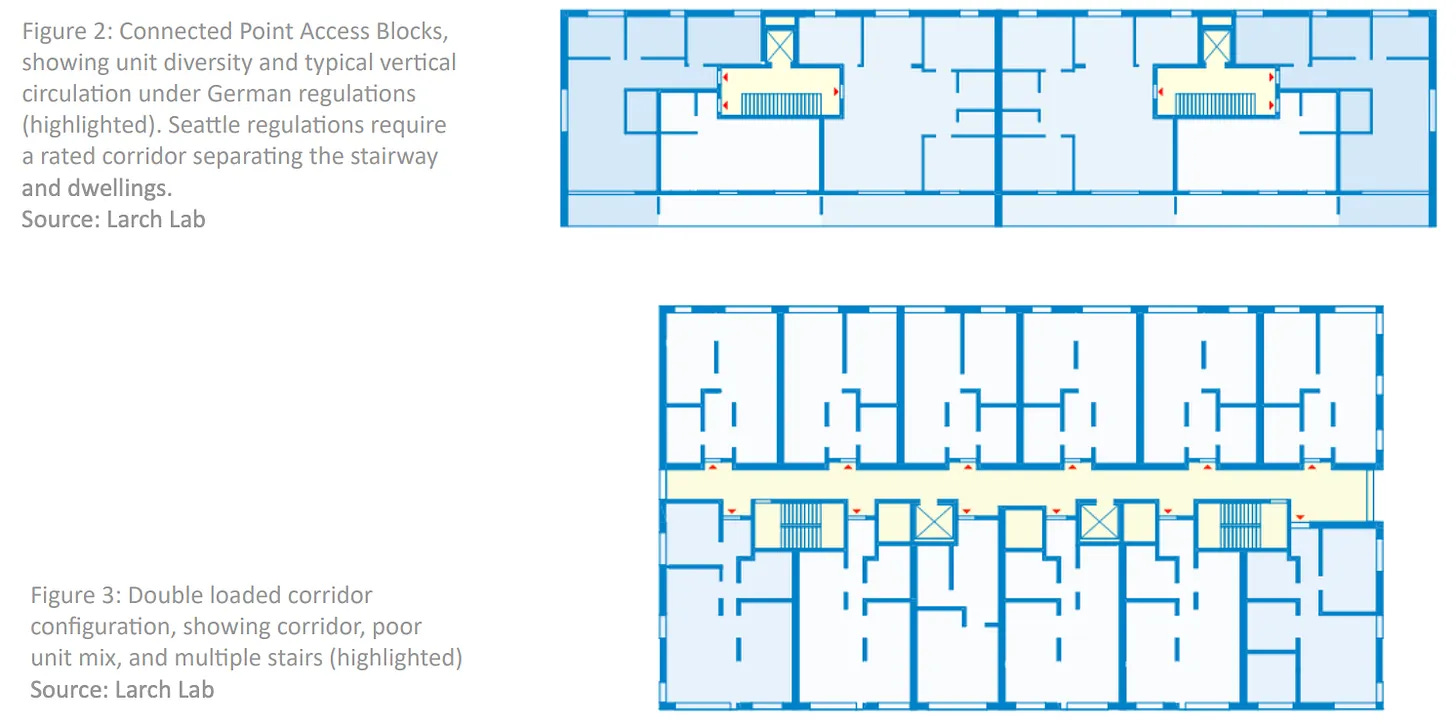
In the US (and a lot of other countries), hallways in apartments, split the units. So, you have to choose what sun you want. East (Strong Morning), West (Strong Afternoon), North (not a lot of direct sun), South (mid-strength-ish sun all day).
Much of Western (Car-Brained) Urbanism Feels like Hallway Urbanism. Incidental cross-pollination is discouraged. Sometimes, you have to walk multiple miles to get to the mall in your backyard. Here’s a crazy example I found on Reddit.
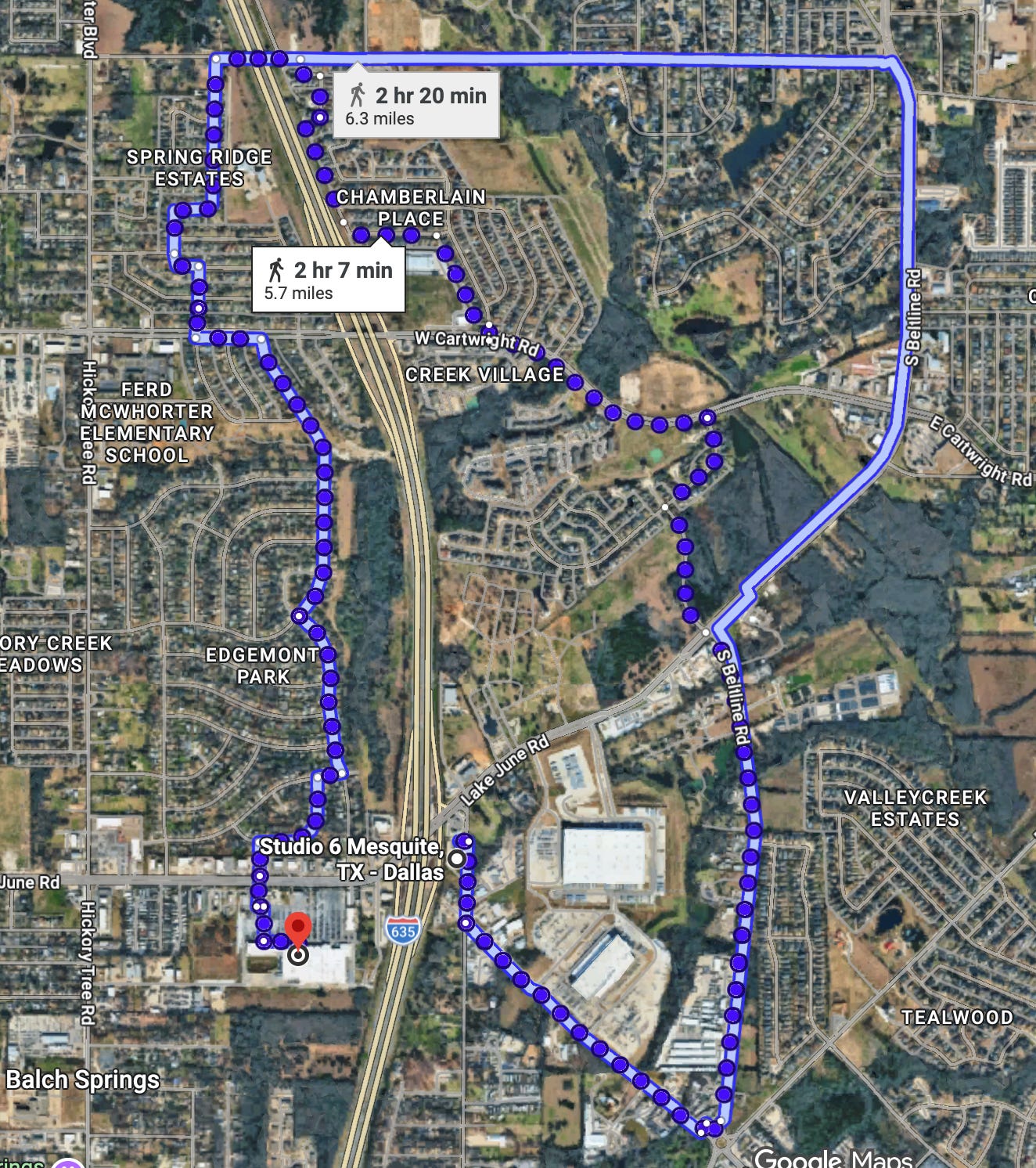
A 4min drive that takes you 31min by public transit that takes you 2h7m to walk! (!)
Once you see Hallways and Enfilades, you see it everywhere.
The Incidental Essay II
Ironically, when reading a braided essay, it felt like I was scrolling a curated social media feed. It was a delight to hop between disparate but related concepts.
The Hallways of Today I
The early web was an enfilade. Each webpage had many doors, pointing you to other rooms. We had web rings and blog rolls; enfilades in shapes: hyperlinking along to the next you might be interested in. Forums, personal websites, etc, it all centered on catalyzing incident. It’s how Google began, by indexing all of these incidents.
It’s only with the invention of the feed that the primary mode of the web became a hallway. One can imagine the feed as a very, very long hallway, and when you “follow” someone there are messengers taking messages from each room and sending it to the follower’s rooms.
But, the people yearn for “incidentality”. It’s thus no surprise that the modern feed eventually came to be replaced by a mostly algorithmic one. You are in your room and the algorithm takes messages from other rooms and sends them to you. But, we enjoy this, because the algorithmic feed surprises us. How often do we delight at the algorithm introducing us to new niches, like in my recent case: interior design, World Cup celebrations, and music from all the over world?
It even makes us feel that we’ve arrived to a physical area/space. The problem with this, is that we can’t hold onto it. We can only explain this liminal space by collecting videos/posts, sharing it with others, hoping they’d feel like they were there too.
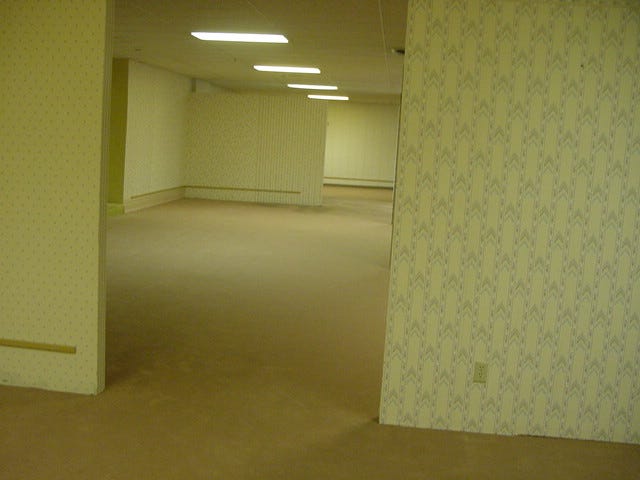
It’s a temporary, bent shape. They feel like enfilades, but they aren’t. We’re simply stuck in rooms next to hallways and all we know is that the shape of it all is constantly shifting. It’s no wonder that backrooms have been successful. It’s how life feels. There’s voices in the distance, but we never really see them.
Hallways You Can’t See I
I was truck by Sachin’s article pointing to how in using LLMs, people are coming to similar conclusions. He states that LLMs pre-commodify ideas.
When we use LLMs we are pulling ideas from the past and re-combining them in a newer, more present context. As multiple people work on the same latent space of problems, we pull forward the same sticky ideas along the same gradients in the latent space, ending with roughly the same ideas.
I agree. If one can imagine the latent space of an LLM, it feels like everyone starts in some room and if you aren’t careful, eventually you find yourself in an LLM hallway being directed to the same room as everyone else.
They pre-commodify ideas and design. As you step into its path, you have to wrangle it, to avoid having it revert to a mean.
It’s why we’re seeing this glut of overly saturated AI posters and similar writing conventions (“it’s not x, it’s y”).

If you told me that these would be conventions prior to their proliferations, I would not have predicted it. It’s like there are hallways we can’t see.
The Invention of Hallways III
There’s a quote from the Robin Evans’ essay that struck me. These were changes that occurred in Victorian England:
With this came a recognizably modern definition of privacy, not as the answer to a perennial problem of ‘convenience’, but quite possibly as a way of fostering nascent psychology in which the self was, for the first time, felt to be not just at risk in the presence of others, but actually disfigured by them.
The invention of the hallway was thus also a moral invention. Initial designs featured both: hallways for the lower class and the enfilades for the upper class.
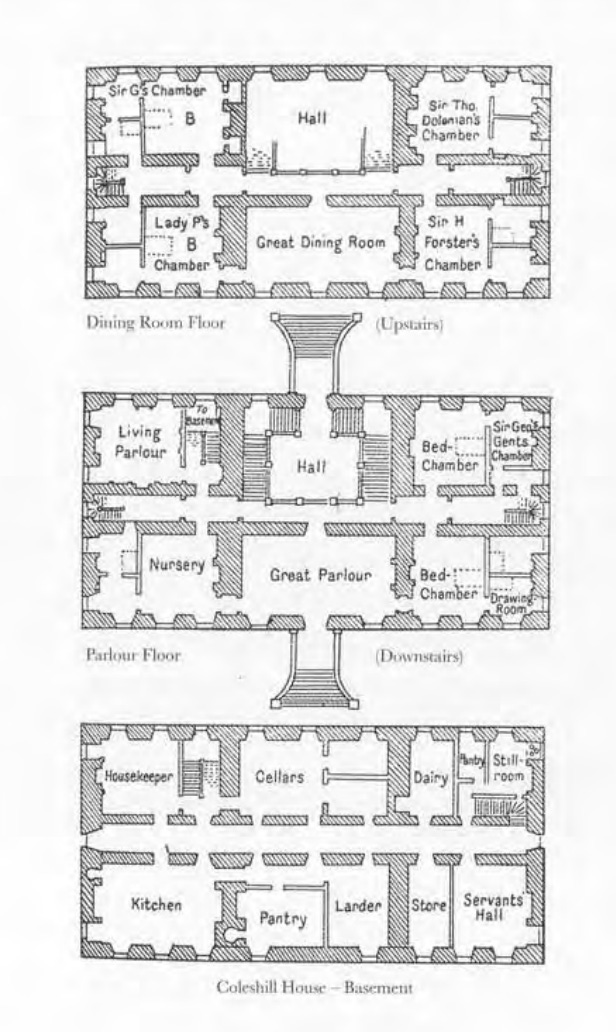
This advanced anatomy made it possible to overcome the restriction of adjacency and localization. No longer was it necessary to pass serially through the intractable occupied territory of rooms, with all the diversion, incidents and accidents that they might harbour. Instead, the door to any room would deliver you into a network of routes from which the room next door and the furthest extremity of the house were almost equally accessible. In other words these thoroughfares were able to draw distant rooms closer, but only by disengaging those near at hand. And in this there is another glaring paradox: in facilitating communication, the corridor reduced contact. What this meant was that purposeful or necessary communication was facilitated while incidental communication was reduced, and contact, according to flights of reason and dictates of morality, was at best incidental and distracting, at worst corrupting and malignant.
The Hallways of Today II
Hallways are great at a certain kind of connection. Privacy is great under certain conditions. But, the concept of an uninvited guest dropping in is so unlikely now, that the modern day apartment has become an extension of the bedroom. Wearing pyjamas all day, working from home, is perfectly normal in 2026.
In some ways, it feels like we’ve made far too many hallways shaped experiences in life, where every in-between is a space to avoid. In some ways, we’re in a crisis of hallways.
The Incidental Essay III
Conversations are more like enfilades than hallways. There is a sense that it tends to lead in novel and new directions, sometimes not staying long enough on one topic, going into recursive depths before potentially circling back to a “anyway, so coming back to my story”.
Hallways are monologues. Enfilades are conversations. It’s supposed to be incidental, tangential. Full of detours.
The Hallways of Today III
I don’t think we’ll see a resurgence of enfilades in architecture, but I believe there’s a desire for enfilade shaped experiences elsewhere. I got my first cellphone at 13. I didn’t get to experience what adult life was like when you had to just commit to things without being able to communicate effectively. You’d just miss people if they weren’t around. Focal points were more important (like a local center or pub). Life was more enfilade shaped in general. Yes, you had to plan more, but incidental life also happened more.
A retreat to pre-smartphone life isn’t what most people would want, but I believe many people want/desire enfilade shaped experiences that isn’t 1) making homes feel like European palazzos or 2) tossing out smartphones.
I’ve spoken about this before, but I feel the modern run club is a great example. Informal, incidental, and the most minimal benefit you get is that you’re still running to get healthier. It’s finding things you did anyway, but doing it with other people. The people is the bonus.
An example is an enfilade shaped cinema/theater (that I’ve shared before):
It’s actually baffling when you consider that when you go to a chain cinema these days, you’re watching a film with strangers. But, you all just saw the same thing, and it’s such a ripe opportunity to engage with the people who just saw it. Open up opportunities to mingle, talk to strangers, meet like-minded people. In some way, do it like a run club. Meet each week for a film and afterwards over snacks and drinks discuss the film with strangers that become friends.
We’re in an era of people turning off the internet and wanting physical connection again. It’s *right there*. Remember everyone watching Game of Thrones in bars? Cinema can so very easily compete with home streaming by simply having the context acknowledge the strangers watching it with you again.
Priyanka Desai wrote about the millennial midlife crisis, striking two sides of a barbell: loud, performative optimization + health maxxing on one end and a quiet retreat on the other end.
Every option is either an optimization or an escape, and the format treats them as interchangeable, which tells you something about the actual shape of the thing.
Which to me signals the general response to midlife: the desire for control. And my sense is, is that both responses are actually desires for enfilade shaped experiences.
The quiet end is group chats, not feeds.
The loud end is run clubs, bathhouses, and run raves.
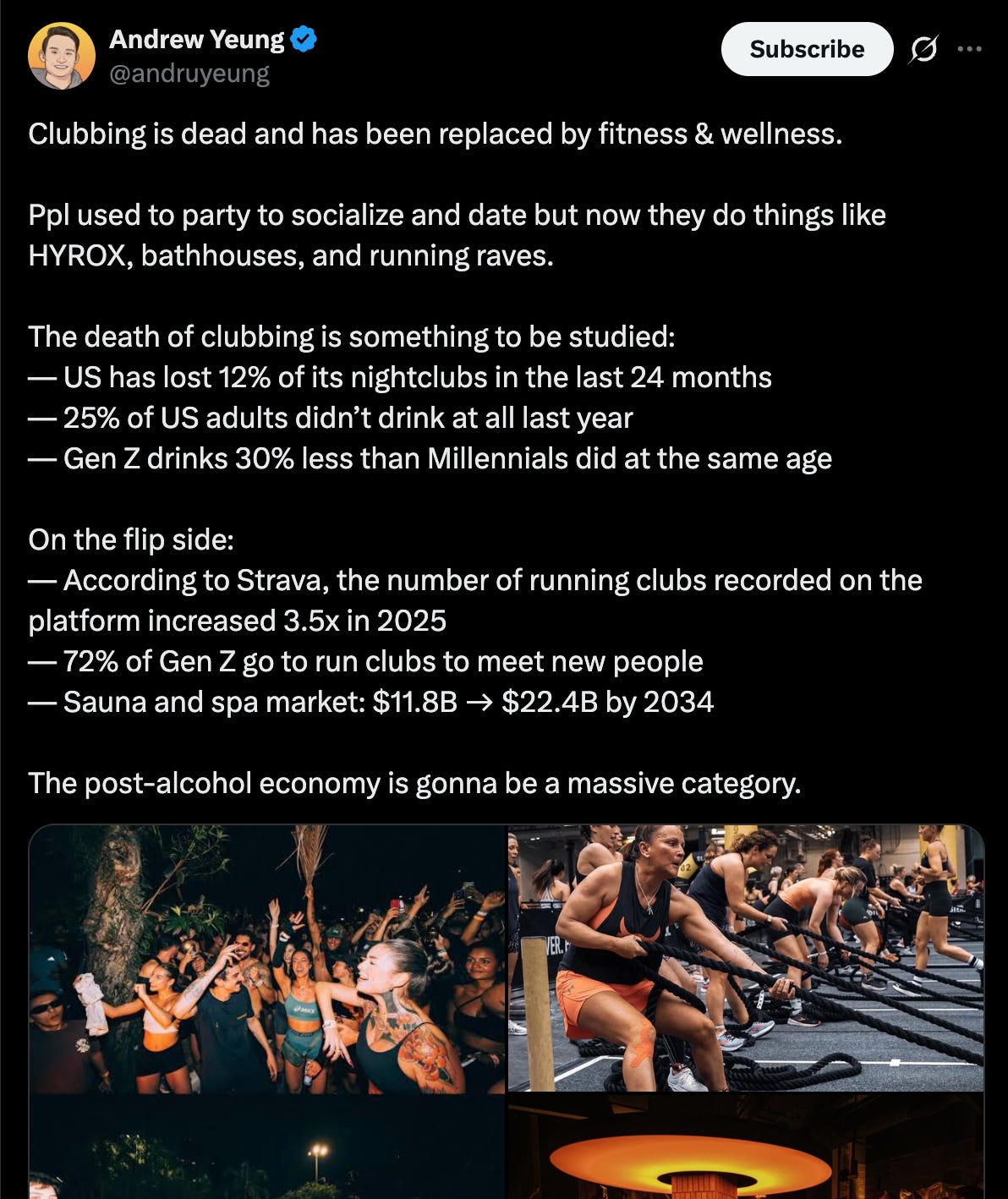
Hallways are like highways. When you miss the exit, it could take a while to come back around. Enfilade shaped experiences have friction, but they’re also new connections.
Admittedly, I’m not 100% sure why the broader response is towards health and not the usual vices (+ enfilade shaped experiences around vices). I think it comes down to an increase in measurable/legible health (Oura, Whoop, Garmin, Apple, etc). Once you see sleep scores and how things like alcohol affects it, it changes a lot downstream of it. But, my suspicion is, is that extreme optimization is a hallway shaped experience. Health is a big thing now, but I think the pendulum might swing back to a better balance in the future. Or, if you zoom out, one could say that with a global obesity epidemic that has never been as bad as it is now, we’re simply reverting to a mean of generally healthier and less sedentary life. The jury is out on this one.
The Incidental Essay IV
When we met up to discuss to the braided essay, we had a good laugh. Three of us (including myself) all wore clothes with black and white stripes. A fun coincidence!
Hallways You Can’t See II
More doors were seen as better.
In sixteenth century Italy, a convenient room had many doors; in nineteenth century England, a convenient room had but one.
Hallway shaped life has funnelled all of us through the front door, when in reality, there’s many side doors that we don’t see (ht maja).
(A caveat: I hate traditional connecting doors in hotel rooms. They should be outside in a connected portal with an additional door, not inside the room).
The Invention of Hallways IV
An apparent pioneer of hallways, John Thorpe, noted the following on his plans when he designed the Beaufort House for Sir Robert Cecil:
“A long Entry through all”
That definition feels great. And in some sense, it feels like what modern society should feel like: that we’re defined by our communities. It’s a long entry through all. It’s reminiscent of the word ubuntu, that rests on the Zulu phrase: “Umuntu ngumuntu ngabantu”. A person is a person through other people.
The hallway thus, at least initially, helped to make the home radically connected. Not just each room next to each other, but all rooms are connected to every other room. In the home, however, it also led to eventual loss of incidental life. Hallway shaped innovations did the same. Too many hallways. Too little enfilades.
But on the other side of this definition, there is surely another kind of architecture that would seek to give full play to the things that have been so carefully masked by its anti-type: an architecture arising out of the deep fascination that draws people towards others; an architecture that recognizes passion, carnality and sociality. The matrix of interconnecting rooms might well be an integral feature of such buildings.
Enfilade shaped experiences are an integral part of human existence. Don’t forget to engage with the “all” throughout and around you.
Thanks to the folks at my local essay writing group for introducing me to the braided essay.
Welcome to the June Edition of Scenes With Simon. I had fun writing this month’s essay! :)
Got some more in store: snippets from the web + what I’ve been up to!
Enjoy!
Snippets From The Web
Am I In The Weights?
An interesting tool to see how you’ve been encoded into LLM weights.
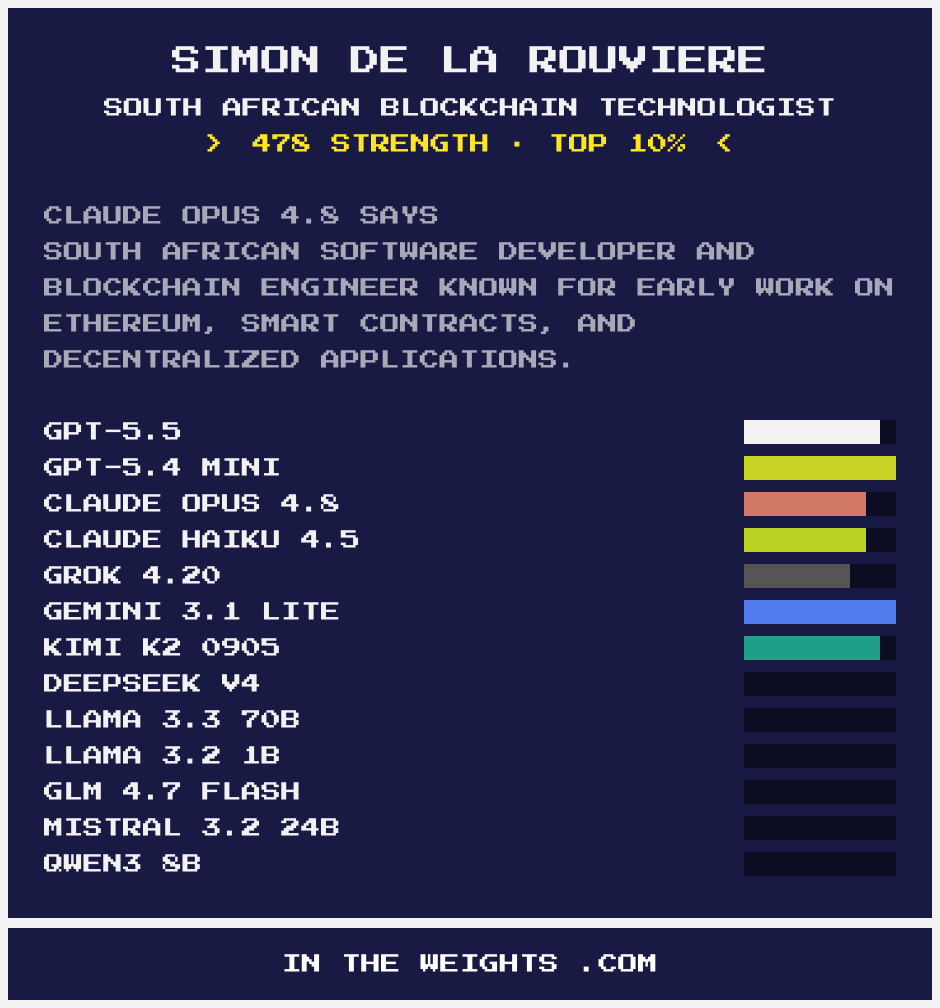
The longer-term implication of this: does it incentivize unique names/naming? Maybe. Maybe not as disambiguation feels possible.
Append-Only Agent Logs
I haven’t had much time to code/play with AI agents. But, this project (activegraph) came through my feed.
A persistent world for long-running agents.
A shared graph of beliefs, tasks, evidence, decisions, and dependencies — derived from an append-only event log. Replay, fork, and diff any run.
Blockchains are append-only logs. And so I remain fascinated by how software interacts with memory and what becomes possible if logs can be trusted. It does remind me of Urbit (computers with append-only logs as 1st citizen). I wonder if these could intersect with blockchains, giving AI agents the ability to spawn/fork from trustworthy logs. Definitely tickles parts of my brain that became fascinated with blockchains.
Exodus 2
This month, David Rudnick’s NFT Poem experiment continued with its latest auction. Launched in June 2021, it releases new collectible automatically on a reverse fibonacci schedule. The next one is in ~5 years. The final one is in ~35 years. Too cool. Peak usage of blockchains as medium.

Recent Survey on Onchain Art
Enjoyed this overview of projects from Takens Theorem that utilize the blockchain as medium.
The Gaspard House and Mid-Century Modernism
I’ve gone down quite some rabbit holes recently in appreciating good architecture/design. Open Space channel is one of them. And then this video, was also a delight.
What I’ve Been Up To
Creating:
✍️ Writing - Novel #2
Writing is continuing well. Really enjoying this revision. It’s feeling very much more lived in and expansive as I’m proceeding. Still hoping to have a finished revision done by end of July so I can start querying again! Here’s hoping! I’ve always been more optimistic in practice, but either way, feeling closer.
Consuming:
📺 Watching
Been enjoying spending weekends kicked back with no real agenda to what TV is being watched. So, just been browsing Netflix and Prime and going off that. :)
The Drama
Before a couple gets married, a disruptive truth about someone’s past presents a challenge to their relationships. This was a hard watch, but I ended up really enjoying the themes of it. Are we defined by our thoughts? By our past? When do we extend grace or forgiveness? How do we deal with hypocrisy? All wrapped in a nervous deadline of an impending wedding!
Life List
A fun “feel good” movie with a fun premise. To get her inheritance, the main character has to follow a list of things her younger self had promised to do. Some of the scenes were very “family telling family about family” vibes.
Office Romance
No need to describe this one. It’s in the name. Cheesy, funny, and a good Netflix popcorn movie.
Voicemails For Isabelle
This really surprised me. After a woman’s sister dies, she sends voicemails to her old number not aware that it’s being sent to someone else. On its surface, a romantic drama, but with a very strong through line of dealing and managing grief. I wish the male lead was a bit more fleshed out though.
Fall Guy
Fun, action film where a stuntman pines over a director. After a back-breaking fall, he is invited back to set. I feel like I enjoyed this more because it was self aware about being a film. I mean, in one scene, the characters literally describe the header of one of the “Save The Cat” beats. 😂. I know it’s a film about stuntmen, but I did feel it could’ve landed better if it was a bit shorter. The novelty wore off, but still managed to stick the landing (actually, yes, pun intended).
📚 Reading
Getting back into reading more books that could serve as potential comps for my novel. Hope to finish some of them soon and review them for next month’s newsletter!
🕹 Gaming
Haven’t had much time for gaming recently. I still want to play Blue Prince and Esoteric Ebb at some point.
Mixtape
I did give Mixtape a go. It’s an adventure game/story of a group of friends at the end of high school in the 90s. I still need to finish it, but I must say, I did grin from ear to ear during the scene where they play Silverchair. It was a huge staple of the 90s/00s for me, listening to them!
⚽️ World Cup
I’ve really been enjoying this year’s World Cup. Was so glad South African went through to R32. Sadly, a frustrating loss against Canada at the tail end of the game. Looking forward to the rest of the tournament. Hope we get some interesting upsets!
I’m also still a 2010s sucker and enjoy seeing cultures celebrate each other. It was a joy to see everyone have a good time in the group stages.
🎶 Listening
hey, nothing - Arteries
What a great track. Cinematic. Felt like a mix of midwest emo folk meets Richard Linklater meets Americana. The music video definitely adds to the ambience!
Madeon - Super Platinum (feat. Erick the Architect)
Love the energy of this. Feels a little like Madeon’s take on Gesaffelstein.
Young the Giant - The Walk Home
Over the years, been listening to Young the Giant, and caught them live for the first time in June. A great show! I’m so glad they played “The Walk Home”. My favourite song of theirs.
And under new conditions, we are not alone!
That’s it for this month, friends. Hope you get to enjoy a lovely sunset as the solstices turn!
See you at the end of July!
Simon
Like what I write? Please consider becoming a patron below ($5/month):
OR: Buy a copy of my self-published debut novel and leave a review!