

Welcome to Scenes With Simon. A monthly newsletter about many things. This month is about bringing back the midlist of culture: power-laws, culture, antimemes, information ecologies, and going offline.
Culture today has two contradictions: everything exists (“long-tail economy”), and yet, popular things are more popular than ever (“superstar economy”).
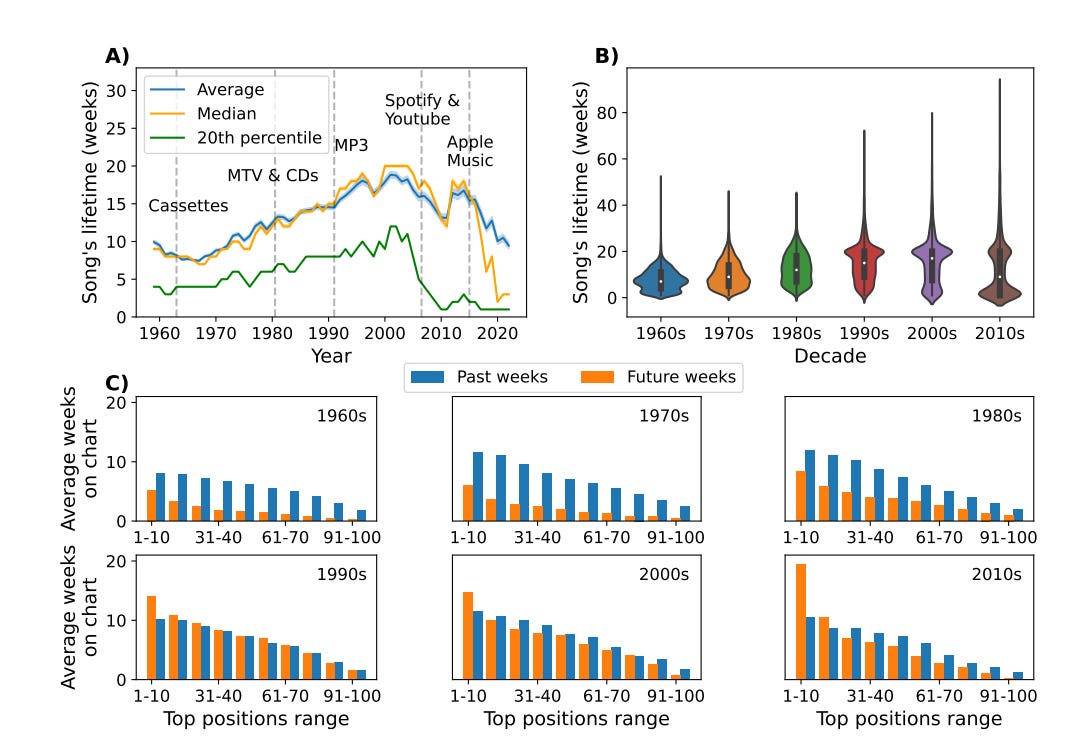
In this excellent study, you can also see that as time went on, the Billboard 100 became less egalitarian. Top songs linger, but the bottom quarter of it rotates much faster than the 60s.
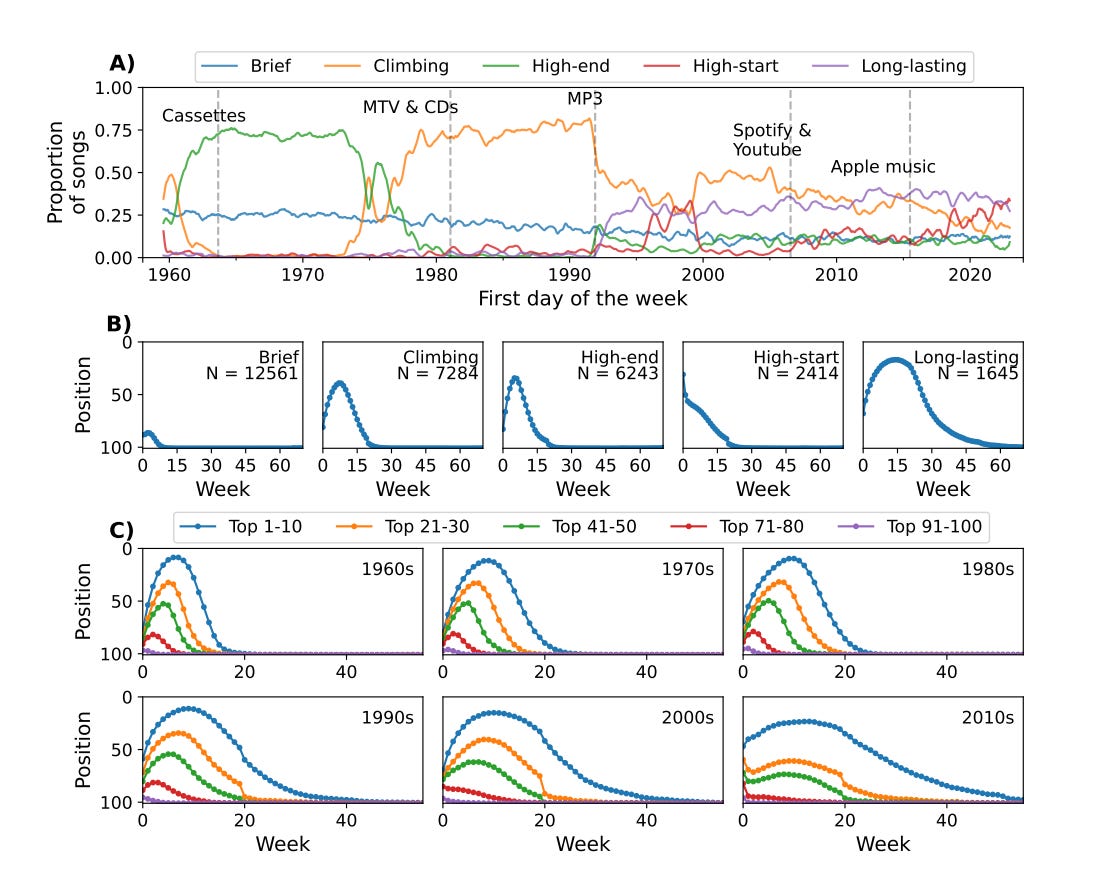
In other words, their conclusion:
Two competing and seemingly contradicting theories concerning the skewness of the music market have emerged in the literature in recent years. These theories can be referred to as the “winner-takes-all” theory and the “long-tail” theory. The supporters of the winner-takes-all theory say that some superstars can capture a significant portion of the market with just a few songs. On the contrary, the long-tail effect states that more and more audiences switch to less popular artists, decreasing the concentration around the most famous performers. Interestingly, in our work, there is evidence that both effects are present in modern music. Our finding that songs debut at better positions and have longer chart lives may be due to the winner-takes-all superstar phenomenon. Conversely, the “long-tail” effect can be spotted in the increased traffic in the chart’s bottom positions and shorter lifetimes for poor-performing songs.
This increasing concentration at the top can also been seen in the film industry:
In the early 2000s, the top ten grossing movies each year made up about 25% of the total box office. That number has been creeping up since 2015 reaching 45% in 2025. At the same time, the number of releases from the major studios has been declining. We see fewer movies making up a larger portion of the box office each year (i.e. concentration).
The fiction publishing industry is a bit more opaque in terms of sales and numbers, but I also looked at NYT Bestseller Lists (which is still partly editorialized to this day). Notably, I had to stick to hardcover releases since since combined print + e-book only lists only came out from ~2011. This means that the data should be far less consolidated because it only covers physical print releases, usually, in the launch period of fiction (from the music industry, physical album sales today are more egalitarian than streaming).
Even in hardcover fiction bestsellers, however, there’s noticeable trends.
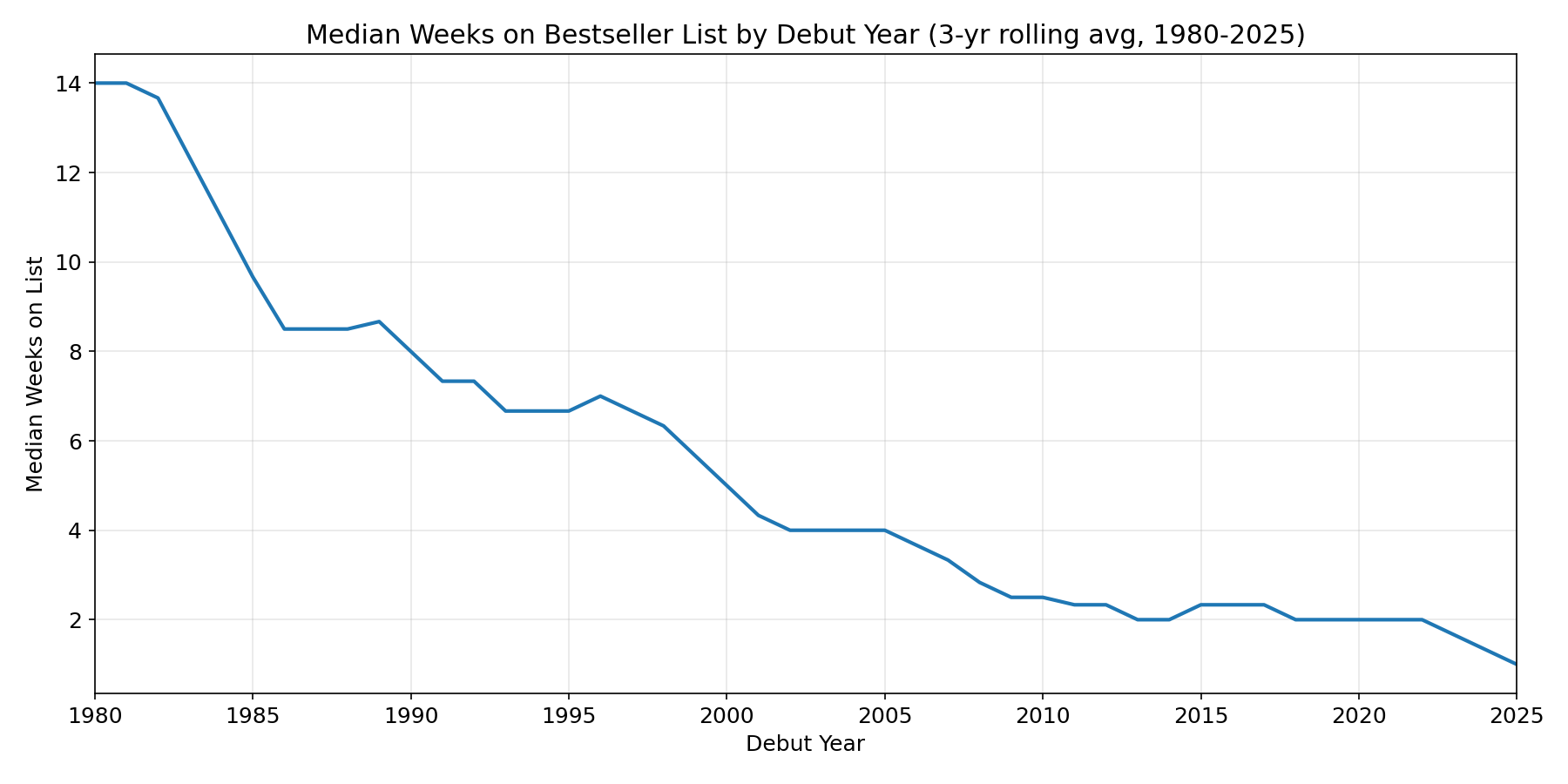
Over the years, churn has broadly increased.
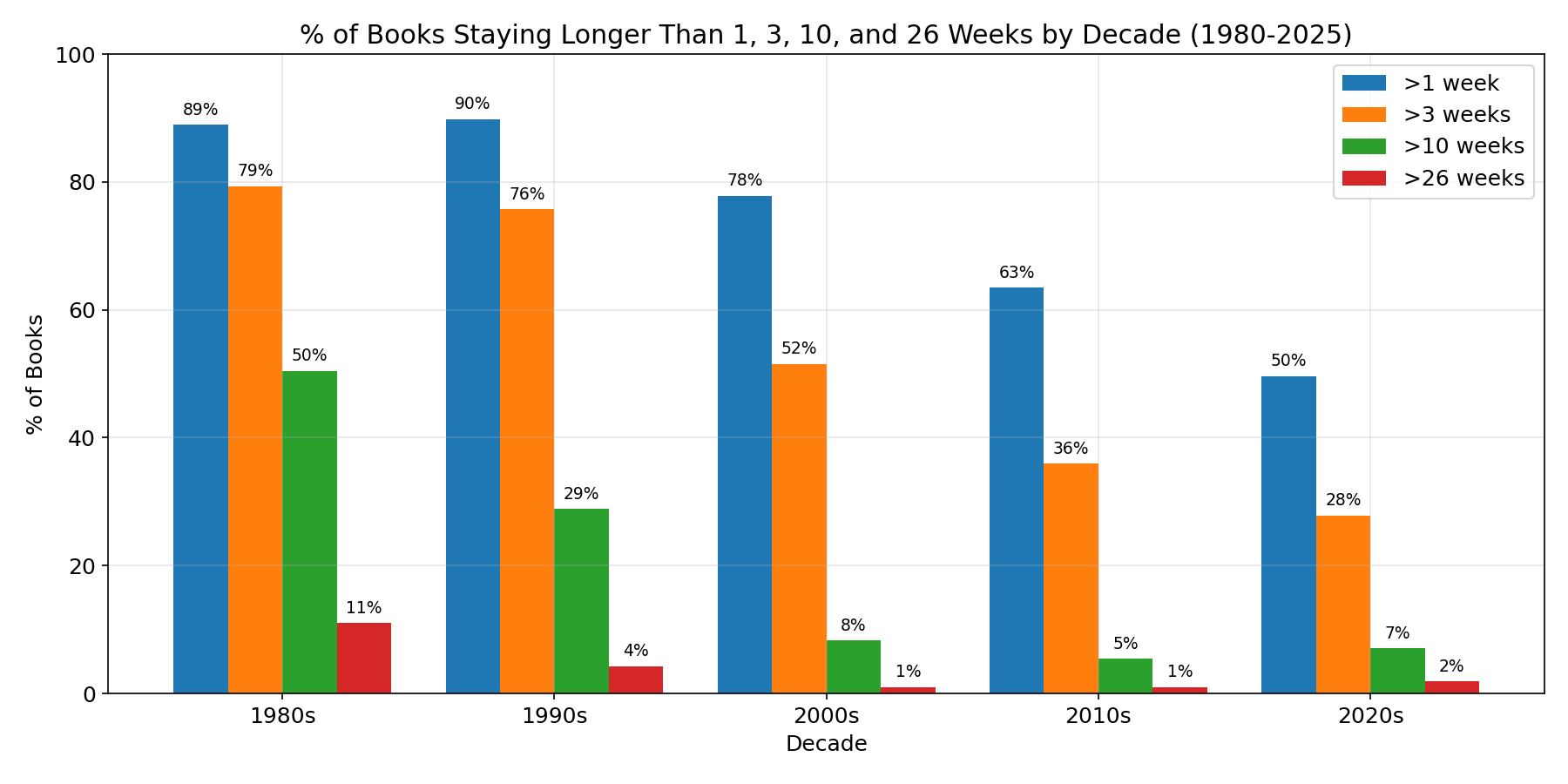
Drilling deeper, however, in the 2020s, the majority of hardcover books only stay a week on the list, but the books with staying power (> 10 weeks on the list) have stayed roughly the same since the 2000s.
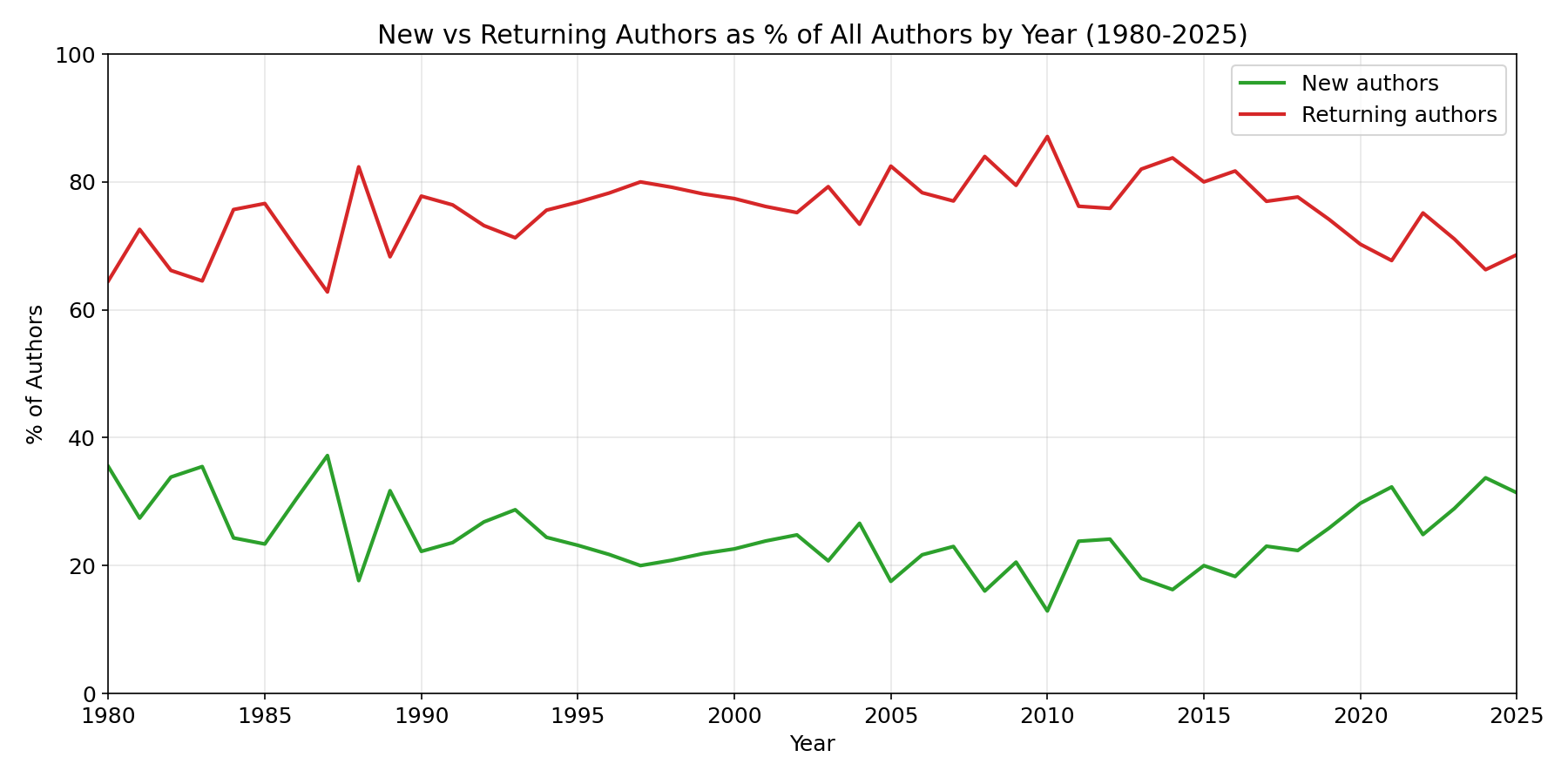
While new vs returning authors have stayed relatively stable:
The top authors take up more of the hardcover list over time.
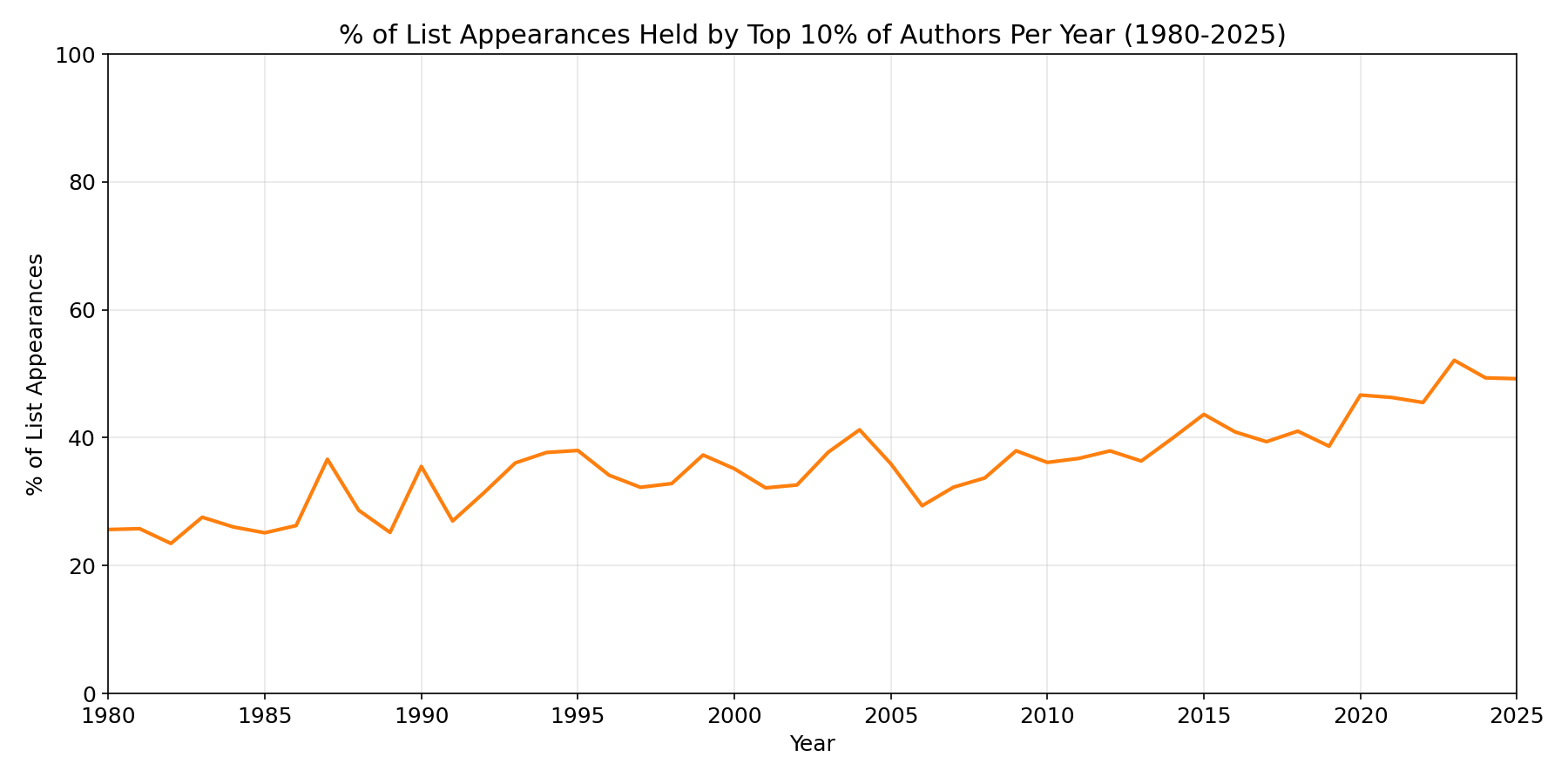
What’s happening, seemingly, is that authors occupy more of the list in different spots as readers buy into their entire bibliography. In 2025, for example, Rebecca Yaros had 87 appearances with 4 hardcover books.
(Sidenote: I really wish I could find/use BookScan (includes sales) or redoing this but finding data sources that include paperback + ebook sales too. It’s likely that this will show more consolidation. For example, Colleen Hoover dominated paperback sales, holding more than half the top 10 spots at one point, but have not dominated hardcover sales).
In the age of the web, it appears thus that the middle of culture has eroded. Popular things are more popular while the bottom churns more.
This has resulted in the loss of not only culture’s resiliency and dynamism, but society’s as well. Losing the middle of culture also means we’ve lost the “middle” of status games. This has bred increasing resentment, fascism, and authoritarianism. To recapture a more resilient and dynamic world, we need to temper the primacy of the web as the center of our information ecology.
There’s a corner of the web that have pointed the way, and it starts with the idea of antimemes.
Antimemes & Information Ecology
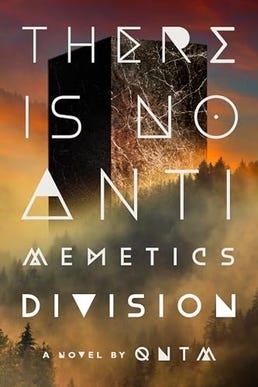
In qntm’s “There Is No Antimemetics Division”, antimemes are defined as memes that are self-censoring or self-concealing. It resists being remembered or shared. In the context of the story universe, it takes on an even larger conceptual bent: that there are anomalous entities that resist being seen (reality warping) or that eat information from human minds.
Similarly, Nadia in her excellent book on Antimemetics describes antimemes as such:
Memes want to be shared. When we come across a particularly good meme, our first instinct is to pass it onto someone else. Memes reap the benefits of these urges by spreading rapidly from person to person - like a virus - burying themselves into our respective cultures. Antimemes are the opposite. When we encounter an antimemetic object, there is a reflexive desire - consciously or not - to suppress it.
She uses example like taboos, open secrets, whisper networks, secret societies, and hidden languages as past examples. But now, with excessive abundance of information and the algorithmic web, the public square has reached its apex and has become a “Dark Forest” (ht Yancey Strickler), one where fresh ideas are readily neutered.
The internet of today is a battleground. The idealism of the ‘90s web is gone. The Web 2.0 utopia — where we all lived in rounded filter bubbles of happiness —ended with the 2016 Presidential election when we learned that the tools we thought were only life-giving could be weaponized as well. The public and semi-public spaces we created to develop our identities, cultivate communities, and gain in knowledge were overtaken by forces using them to gain power of various kinds (market, political, social, and so on).
As a response, there’s been a retreat into the cozyweb: group chats in Discord and Signal (from Venkatesh Rao ):
Unlike the main public internet, which runs on the (human) protocol of “users” clicking on links on public pages/apps maintained by “publishers”, the cozyweb works on the (human) protocol of everybody cutting-and-pasting bits of text, images, URLs, and screenshots across live streams. Much of this content is poorly addressable, poorly searchable, and very vulnerable to bitrot. It lives in a high-gatekeeping slum-like space comprising slacks, messaging apps, private groups, storage services like dropbox, and of course, email.
Nadia describes these spaces as the shadow city (in part, in reference to China Mieville’s novel, City and The City):
If the memetic city is characterized by bright, flashy, Times Square, the antimemetic city is more like a city of encampments, strewn across an interminable dessert. While some camps are bigger and more storied - think long-established internet forums, private social clubs, or Discords - its primary social unit is the group chat, which makes it easy to instantly throw up four walls around any conversation online.
These spaces are seen as antimemetic, because the ideas shared in them are less likely to spread outside of its confines. Memes that eventually make it into the public has to escape, what Nadia calls, their drag co-efficient.
The overarching essence is thus: memes exist on a spectrum of more likely being shared (memetic) or more likely to resist being spread (antimemetic).
But, I’m not entirely satisfied with this distinction. It presents itself as a spectrum. It breaks down when you extrapolate it to extremes: no meme (yet) is entirely memetic and no meme is entirely antimemetic. If it was entirely memetic, then it would be an idea that is far greater than Nadia’s description of “supermemes”: it would be so powerful as to put humans into a catatonic state. Imagine slop so viral that humans die from being unable to do anything else. An entirely antimemetic meme is a divide by zero. A meme that has existed, by nature, had some memetic properties. Some memes have died yes, never to be remembered or conjured again, but there’s no entirely antimemetic meme, because it would never come into existence.
Rather, both Nadia and Venakatesh Rao allude to a different approach.
Venkatesh in his review of “There Is No Antimemetics Division” says:
But the same is not true of memes. Memes happen to be adaptive for humans, since they power our cultural evolution, but they need not be. Clearly there are creatures whose survival depends on antimemetic phenotype traits, like camouflage coat patterns. Humans too make use of secrecy and stealth in some behaviors. The generalized notion here is powerful. Maybe every creature has a communication phenotype that’s X% memetic and 100-X% antimemetic.
And Nadia, in describing memetic drag co-efficient says:
Immunity and transmission rate are determined not just be the qualities of the idea itself, but how receptive its nodes are (us). The same idea might be memetic within certain networks, but antimemetic in others.
…and a few paragraphs later:
Changing the properties of the idea - such as the format or structure it’s presented in - can influence a network’s transmission rate and immunity, but these properties are always subjectively defined by what resonates with the network.
Memes are better seen as organisms that live in an ecology of information. A creature that evolved to be unseen (antimemetic), like a stick insect, thrives in context of its environment (a place with similar looking sticks). But, put a stick insect in a museum and its the first thing you see as something that stands out to be extraordinary. There, it’s far more memetic (“Dad! Look at this stick insect!”).
The idea that group chats are antimemetic feels off, because as Nadia alludes, its actually more memetic for memes that do not yet thrive in the public part of the information ecology. It’s publicly antimemetic, but privately, memetic.
While Twitter was once a place where you shared what you had for breakfast, group chats are now often the space for the mundane. Sharing your breakfast publicly is antimemetic. It will resist spread there now because its not fit for that space anymore. But, sharing your new cereal you bought with your best friends in a group chat, is actually something worth talking about (or, you know, maybe it’s called being in your 30s). They, in turn, might opt to buy it, to try it.
Thus, a meme’s memetic or antimemetic quality is entirely context dependent on its environment.
Information Ecologies
If we take up the metaphor of an ecology, there’s a further extrapolation from here. When you introduce memes into a specific environment, like introducing an invader plant to an unprotected biome, that meme can not only come to erase and suffocate the environment’s general diversity, but also reshape the ecology itself. If you turn a wild garden into an acid-green lawn, you’ve reshaped its ecology. It’s then less likely to survive flooding events. On a broader scale, for example, removing beavers from an ecosystem, can result in more flash flooding due to less dam breaks in the ecosystem. Memes have virality and resistance dependent on its environment. One organism thrives or dies in different biomes.
It’s thus not wrong to draw the conclusion that when we reshaped our information ecology by reducing the cost of sharing information on a global scale, we’ve not just made it possible for memes to spread more, but also allowed specific memes to reshape our entire information ecology.
Memes fed the feed and replaced our communities. We’ve made our information ecology into one that’s entirely that of a monocultured lawn. In most cases, do we really need monocultured lawns or would an ecology be better fit as a wild garden?
What we’re left with is a confused feeling that while everything exists, it’s also become stale. The 2020s does not feel as different to the 2000s as the 2000s did to 1980s. Popular things today are more popular. We’ve turn our entire information ecology into one that caters to one crop: that of the memes in the feed. The diverse, resilient, and dynamic middle has been hollowed to create massive ideas and a very, very long-tail of the rest on its periphery.
And downstream of culture is status. From an era where many status games existed, it’s been blown up to a big few. If everyone has to compete in the same game, it breeds resentment, fascism, and authoritarianism.
If we want society to rewild a bit, it means recognizing the following:
It’s imperative that we situate the public algorithmic feeds as more equal to the rest of our information ecology. It’s not the beginning and end. It means going back to using group chats. But also, simply going offline again and investing in local communities. It’s not saying we should toss out the public web and algorithms. But, it’s one part of the ecology, not THE ecology.
Think of adding healthy friction/interruption back into your life. A key figure here to support this is this: physical album sales are more egalitarian than streaming. More physical is better than only digital.
Realise that some memes actually exist better in environments that’s not the public web. Not all memes need to graduate to the “public” either.
Increase your own cogsec (cognitive security). Like with your nutrition, be aware what you consume, where. Most people simply consume memes without being self-aware. It’s already bad, but it’s going to get 100x worse with generative AI everywhere. Context has always been important, but it’s moreso right now. Instead, look up.
We’ve all noticed the consolidation of culture over the years, and in part it’s because we’ve reshaped our information ecology by catering our information ecology towards the algorithmic feed. In turn, memes that thrived in that environment captured a larger share of our attention away from information ecologies that provided healthy stopgaps, diversity, and resilience. We can simultaneously revive the middle-class of culture by resisting the memetic algorithmic feed and in turn not only bring back more sustainable diversity, but perhaps, also repair a few parts of society that has felt like it has deteriorated beyond reconciliation.
Make life a bit more antimemetic in general. If anything, this essay shouldn’t go viral. Not all memes should. After you’re done with reading this, don’t share it online: rather, put down your phone and go outside.
Welcome to the February Issue of Scenes With Simon. Special thanks to Hawes for hosting an excellent NYT Bestseller dataset (I donated). Also, thanks to my local essay writing group for early feedback on this essay.
Some more goodies ahead:
Sincerity and That Alysa Liu Performance
Snippets From the Web
What I’ve Been Up To
Sincerity and That Alysa Liu Performance
There’s been a lot of chatter on Alysa Liu’s performance at the Olympics. You can watch it here.
Notably, many people have been delighted by the performance due to her ease and joy she exuded throughout. Anyone that has pursued something has wrestled with the ego promoting the endeavour’s seriousness over effortless and unattached excellence. We sometimes feel that in order to succeed we have to take it seriously and we have to put our own identities and selves on the line to achieve greatness. And so, excelling without ego feels like a high level of mastery. To endure sacrifice and not desire to win, but to simply enjoy the stage. That’s hard and an amazing and admirable place to arrive it.
On top of that, I sense that in a time where our leadership and supposed role models are often rife with moral decrepitude, we seek sincerity again. In some sense, when times are good, sincerity feels like extra frosting on a cake. It’s too much. Almost naive. But, when times don’t feel good, sincerity rises again as a virtue, as strength.
I’ve often felt at odds with the cynicism of the 2010s. I’m glad sincerity is coming back. More on this later in the newsletter.
Snippets From The Web
I wish I had more essays to share for February, but reading both books and doing the research took up my most of my newsletter writing time this month. So, instead. More snippets for this month!
Eating Alone In Another Country

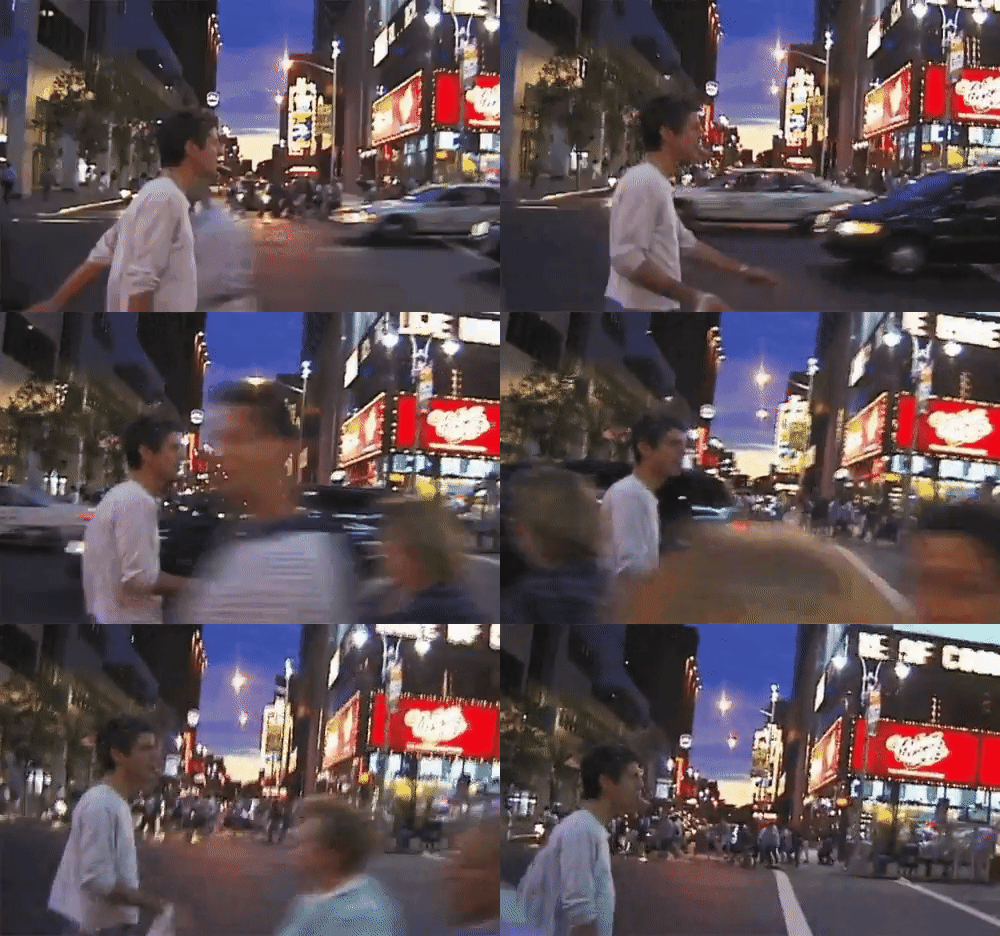
For a few years (~2015-2019), I was travelling by myself all over the world and speaking at conferences on blockchains. The most memorable moments were times where you simply alone in a vast new city, unseen. It was like society around you becomes a blanket. I’m always reminded of the Speed Levitch quote from Waking Life: “On really romantic evenings of self, I go salsa dancing with my confusion”. There’s a great peace to times like that.
Where Is The Light Coming From?


Regardless of it being real or not, it’s a great reminder of how to approach storytelling. Don’t let reality get in the way of a good story.
Pixel Maps


Map nerds are going to love this one. Great to fly around NYC in this.
Alcohol Decline
I remained fascinated by this trend.


Why now? Is it a trend that will continue? I’ve definitely been drinking less, but I ascribe it to simply being in my 30s now and my body does not accord so well with it anymore. 😅
The Top-Heavy Economy
Speaking of top-heavy…


Population Density in the US
Loved this tour over the US from CityNerd.
Scanning Books into LLMs
You know. I knew frontier labs were scanning books for LLMs, but this image truly stunned me.


The Backrooms Movie
Some of the Backrooms videos usually incorporate some horror elements. The new A24 Backrooms movie will likely have it too (considering it’s from Kane Parsons).
…but, I always felt that Backrooms were fascinating in what it doesn’t show. I would love an ultra mundane take on Backrooms. That it’s just incomprehensible exploration of capitalist “boring jobs” subconscious. Like Neo taking the blue pill and just living a life, forever, in an office job. Severance did this really well with its maze-like elements. Or like Being John Malkovich where the office exists on a half floor.
What I’ve Been Up To
Creating:
✍️ Writing
Primarily still working on revisions, but it’s all coming along very nicely. Really happy with the direction it’s going in. Not much more to add here besides being heads down and revising!
🖼️ Art
I refactored and updated the UX on “This Artwork Is Always On Sale”. It’s still doing its thing, but should some small QOL improvments. Hoping to do the same for Neolastics soon!
👨🏻💻 Coding
Slowly, but surely getting back into more coding thanks to Claude Code. It’s really sped up timelines for work. I still kind of want to figure out a routine or process to let Claude Code run more often while I’m doing something else. But, I haven’t been able to really imagine how that fits in. Funnily enough, it’s also because it works so well.
I used Claude Code extensively when I was doing research for the tentpole essay. I wish I had this when I was doing graduate research. It’s so great to generate new lenses into data.
Consuming:
📺 Watching
Hamnet
Hoping to make my way through more of the well nominated films this year and Hamnet is one that stood out. I enjoyed Chloe Zhao’s Nomadland, and I’m probably one of the few MCU fans who loved The Eternals. So, I was excited for Hamnet. It ended being far more tragic than I thought it would be. It’s a hard watch, but the film’s best moment is the end. Deeply moving.
A Knight of the Seven Kingdoms
Not really enjoying grimdark fantasy recently. The world’s complicated (and corrupt and full of people in various horrid files) as it is. So, I was lured to this after seeing it being more hopeful than the regular GoT political dramas. It’s great to be back in the GoT universe. And I’m enjoying watching TV that’s focused on people who try to hold their values at high cost. With that Alysa Liu peformance being in the zeitgesit as well as AKOTSK, I’m liking that high integrity and sincerity is back.
🕹 Gaming
Factorio: Space Age
Yip. The voices. It called. It called me back. The factory must grow… Primarily, because Space Age was released on the Switch 2. It’s been my favourite way to unwind in the past month. The mouse controls on the Switch 2 is also better than I thought it would be. I literally play with the joy-con mouse on my pants. It’s not janky at all. In this play-through, I’m doing two big changes. A better “mall”, so that I don’t have to craft many of the items myself. And secondly, a far better rail network. The QOL improvements for rail is so much nicer. Interrupts, for example, mean that I don’t have to send coal to various stations to keep the trains fueled. When it’s low, it simply stops at a coal depot to load up.
Still one of the best games I’ve played.
📚 Reading
There Is No Antimemetics Division by qntm
I’ve been wanting to read this for ages. I’ve written about SCP and researched it extensively before.
Seeing SCP as a Narrative Protocol

This week I was fortunate to do a guest talk with the Protocol Town Hall series.
So, I’m glad, that with the rewrite and republishing of the story, to get around to reading it. I really enjoyed it. I do have one small critique however. Towards the end, it feels like it unravels a bit. In high concept novels, I usually prefer a setup that allows the reader to draw their own conclusions from early exposition as to how it would be solved or completed. Greg Egan novels are a great example of this. It always gets weirder toward the end, but it stays within in its own confines (conclusions are logically drawn from early setups). To put it differently, it feels like There Is No Antimemetics Division starts off as sci-fi (rules and protocols) and ends as fantasy (magic).
That being said, it’s still a highly entertaining high concept novel and would definitely recommend it if you enjoy stories like this.
Antimemetics by Nadia Asparouhova
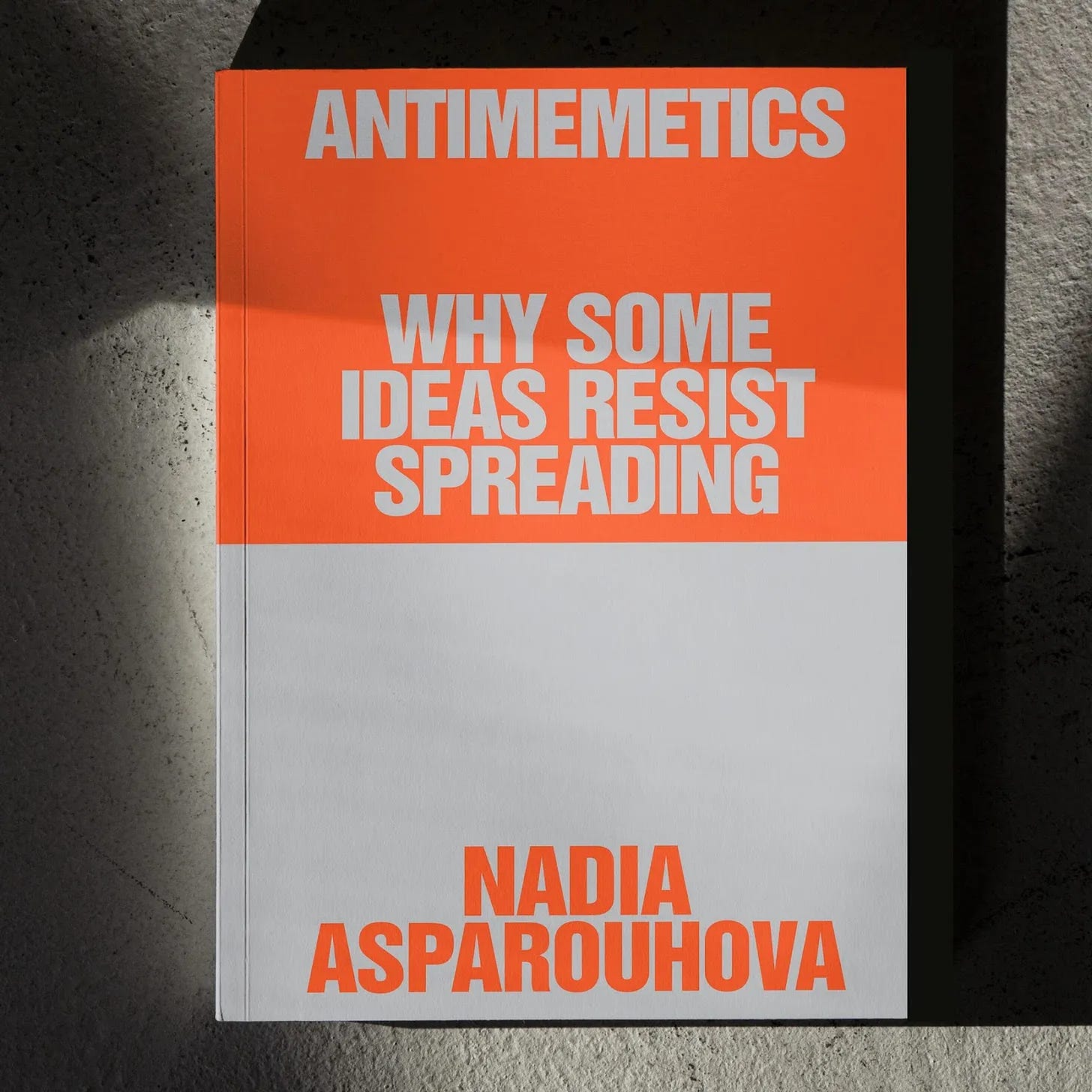
For this month, I set out to read these two books to see how they related to my own theories of memetics and I almost didn’t write about it, because I feel Nadia’s take on it almost said everything I wanted to say. Also, I’m a huge fan of the way it was written, and published. More of this, please!
🏃 Running
The snowcrete and below zero degrees celsius temps for most of Feb definitely hampered my running. But, it’s melted and I’m back in it, ready for a half marathon at the end of March. Going to take this one easy and just have fun with it.
🎶 Listening
Karnivool - In Verses
I’ve had the new Karnivool on repeat. It’s been 13 years since their previous release. They’re a top 10 band for me, and this album is hitting all the right spots. I still distinctly remember how much Sound Awake’s release in 2009 kept me company during a personally difficult time in my life.
It’s one those progressive rock bands where the more you listen to the songs, the better they get. While their 2013 release didn’t land as well as their first two albums for me, album number four has quickly become a favourite. I’m so happy they’re continuing to make music.
Galaxy 2 Galaxy - Transition
I’ve been making way slowly but surely through Resident Advisor’s Top Electronic Tracks of the 2000 - 2025 and this was my favourite discovery. Gosh, the way it keeps building is magical. And the narration is so empowering. What dance music should and can be. MAKE YOUR TRANSITION.
GIFT - Shadow Stealer
A great psychedelic rock track. Been great to run to!
That’s it for February, friends. Thank you for reading. As the Northern Hemisphere begins to thaw, I hope you get time to experience a lovely sunset again.
Until next month!
Simon
Like what I write? Please consider becoming a patron below ($5/month):
OR: Buy a copy of my self-published debut novel and leave a review!
I enjoy reading these, Simon!
What do memes represent ("truths", amusement, attempts at agency, comfort?) or what it is a vehicle for, in society?