

Welcome to Scenes With Simon. A monthly newsletter about many things. This month is about being a creator today, minimal legible forms, and compound culture.
The worst slop, to me, is low-effort creative work that’s marked by its attempt to primarily extract and exploit the audience’s attention. Innovative and interesting choices are discarded in favour of expanding the work’s reach. It’s not to delight more of the world, but to feed on more of its attention. To allow me a bit of woo-woo: the energy of bad slop primarily flows from the audience to the work, rather from the work to its audience.

Slop is not new. It existed prior to generative AI. It was marked as work that focused more on SEO optimization, playing up algorithms on social media, A/B testing gaping mouths and pointing at things on YouTube thumbnails, and consistent fracking of intellectual property by mega IPs. 2010s slop wranglers already learned the art of algorithms and promulgated its wares to the entire world.
But, with generative AI, people don’t have to buy the “23 Tips On How To Get Your Book On Google’s Frontpage” e-courses, anymore. LLMs without any tweaks caters to this bouba middle. No kiki sharp edges anywhere, purposefully built to smoothly pump slop through the lubricated pipes of the internet.
While the past has been marked by recommendations on making one’s work more legible, today it requires more noticeable illegibility. To focus on legibility is like adding water droplets to an ocean. And the ocean is not your context. If you’re using LLMs to boilerplate, you’re diluting your work to purely being functional. As Ben Roy writes:
LLMs don’t operate on the same plane. They have a view, but not my view. They have some context, and maybe often too much context, but not the context that’s relevant to play this game well.
Becoming more illegible is not to be purposefully strange. Rather, it’s an explicit rejection of the need to alter work to fit established distribution. To some, it might represent experimentation into something strange. To others, it might mean sticking to tried-and-tested formulas, if it makes sense for the work.
Here’s examples of advice that often point to packaging one’s work to be more legible:
Cut down your novel to “x” amount of words, because readers don’t want to read that much. Or, the inverse: no one buys novellas, make it longer.
You have to make a TikTok or Instagram account and (forcefully) participate in the conversation to get noticed.
Make sure people can Google your work.
Get blurbs (or other social proof).
Focus on developing a recognizable style.
Becoming more illegible is also not to say one should avoid taking advantage of existing distribution norms, but the question is whether the work can lose its novelty as a result of it. This was always an existing calculation to consider, but this will become more prevalent as slop pushes early adopters of culture more towards its fringes. For example, There is No Antimemetics Division was first written as a creative commons addition to a collective creative project, called SCP. Really interesting work is increasingly not immediately legible. Much of modern work is already extremely context heavy. It’s consumption exist at the tip of deeper context:
We enjoy media by ourselves, but we also *use* media to communicate. Am I being spoken to by the piece of media, OR is the media speaking for me? In this era, the latter is increasingly more relevant because of the ability to share the extra context around the media (the fandom). It’s not that the piece of media has to have a particularly salient social message, but rather that the media can more readily stand in as a replacement for what we feel.
Anything I love these days is usually accompanied by also consuming wikipedia pages, YouTube essays, and subreddits. The work itself is already more than just the work itself. A lot of successful digital work today have grown to an illegible, multi-form fungus that thrives on the moisture of fandoms, oxygen of attention, and the nutrient-rich source of dank internet detritus (also, commonly referred to as shitposts).
So, how exactly does one become more illegible? At its heart, you have to become illegible in your own way, but I have five broad recommendations:
The Illegible Medium is the Illegible Message
The easiest legibility trap is to conform to form. That a fiction story should a be novel. A pop song should be about 3:15 seconds. Or that art should exist in a gallery.
Experiment with form and structure, because form and structure don’t easily translate to algorithmic distribution.
Become a Map
Great fantasy maps are invitations that show that depth exists in the world. There’s always something “yonder”. Slop, if automated, tend to not spill over its containers. So, showcase your context when you can. Show that there’s depth.
Scribble in the sides. Create artefacts of process and share them. Link to your other work. Link to other people’s work. The point isn’t necessarily to manipulate people into delving deeper, but rather to let people know that your work contains a conversation you had. Conversations don’t happen in vacuums. So, become a map, and don’t be afraid to let your work spill over each other. People need to arrive at your work and want to see that there’s an entire world behind it.
Use Social For Media for Breadth, Not Depth
In a similar context: algorithmic social media promotes clustering. If you say and do the same thing, and people like it, it will drive more attention. The problem with this is two-fold. Firstly, creative risks and authenticity are tossed out for more slop. A good example is always when people get successful and they continue to produce facsimile’s of what made them successful, to the point that they become parodies of themselves. The longer they go, the more uninteresting it gets. Secondly, work that’s made for the algorithm, lives by the algorithm. One tweak and you can become a nobody again.
Instead, use social media like it used be back in the beginning: show your breadth, not depth. Talk about breakfast. Post a song. Reshare great art. Review Project Hail Mary. Talk about your work. Show that you’re confused, complex, and full of interesting contradictions.
Write drunk, edit drunk.
Edit, but edit very lightly. Or edit furiously. Don’t edit to conform. Editing with too much purpose risks sanitizing your work so much that it disappears. Make and keep mistakes. Which brings me to the final point.
Noise Is A Part of the Channel
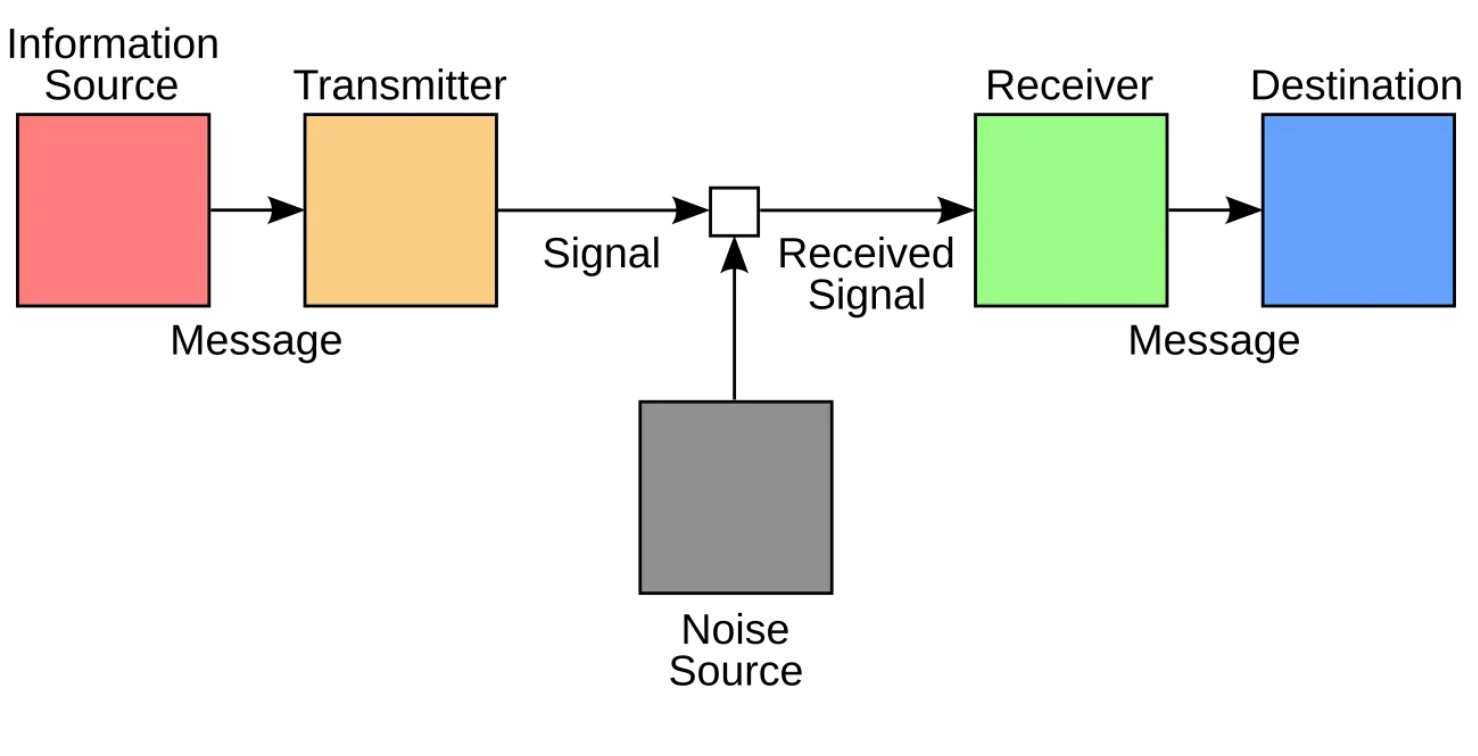
It’s often said that good communication comes with the reduction of noise. But, communication itself does not exist in a vacuum. The act of communication itself is a part of the message when silence can also carry meaning. And so, noise itself becomes a part of the message. It’s friction and accidental eustress that actually carries the message across better than if it was flawless.
Examples: A son whose voice cracks when he talks about the death of his father carries more tears. A letter with hasty ink smudges shows us the hands of the author. We’ve all sometimes discovered live versions of songs to be better than the sanitized and overly produced recordings.
On LLM Slop
You’ll notice that none of this advice precludes using generative AI or LLMs in your work. In fact, skillful use of LLMs can produce wonderful work even if it’s median use is to promote legibility. LLMs are great exploratory tools (ht Mat Dryhurst):
To this end I think reasoning between a human and their system will be a rich addition to publishing moving forward, where taking cues from the observation that writing is a struggle, more benefit comes from inviting others to struggle and reason in those trenches with a text, rather than seeing the text itself as the sole destination.
There’s a Flannery O’Connor quote that speaks to this where she says, “I write because I don’t know what I think until I read what I say.” I’m the same way. I don’t think people can skip doing the work of wrestling with ideas because that’s the core chaotic energy that underpins good writing. It’s how you figure out what you believe and how you want to communicate it.
LLM slop is using LLMs to produce work where the creative is more interested in feeding on your attention than the other way around. Using LLMs to go explore, to test and prod at latent spaces and to arrive back in our reality with newfound insight for the world isn’t slop. LLMs can make it easy to take shortcuts, or it can make it easy to travel much farther than ever before. Don’t use LLMs to feed on our attention. Instead, show us new worlds. Most of all, become a bit more illegible.
In this issue of Scenes With Simon, there’s a few more essays, snippets from the web, and updates on what I’ve been up to!
Factorio, Maintenance, & Compound Culture
NVIDIA’s DLSS 5 and Minimal Legible Forms
Snippets From The Web
What I’ve Been Up To
Factorio, Maintenance, & Compound Culture
Factorio is slowly but surely becoming my most-played game (coming close to hours spent playing Super Smash Bros). I’ve been reflecting on it, and I think there’s something deeper to its success.
Many games, in some form, present simpler cause-and-effect feedback loops to real life. This simplification is also at the core of why gaming can also form negative anti-social tendencies: people feel like they accomplish things as opposed to accomplishing things in the real world. Gaming can present as a space/place where one has more control.
With Factorio, to me, it fulfils two unique niches in this respect:
A World Without Maintenance
Easy Compounding
A World Without Maintenance
In (most of) Factorio (except Gleba), nothing decays. The only thing that generally requires monitoring is the acquisition of new resources and repairing damage from biters. But, machines don’t fall apart by themselves. Once set up and the automation kicks in, the game doesn’t punish you (sidenote: this is interestingly, in contrast to games that uses a decay mechanic to foster exploration, like in Zelda’s Breath of the Wild). This is in contrast to our daily life: the car breaks down and our muscles shrink if we don’t continue exercising. The older one gets, the more one is forced to treat maintenance with magnanimity. You have to find meaning in putting things back together again.
While mechanics like this aren’t new, what makes the lack of maintenance matter is how it’s incorporated into the broader mechanics of the game: that of automation.
Easy Compounding
The core feedback loop of Factorio is that once you spin up a part of your factory, it is subsumed like sediment, generally disappearing into the background. Your smelting arrays, your main bus, your mall, your trains, your pipelines, your labs, it all quietly hums on its own once it is set up. It speaks to the anti-thesis of daily life where automation is still generally fraught with unique niggles, edge cases, and hassles. eg, with my business, my bookkeeping has been automated and I have to sign off on the books every month. But, inevitably, there’s always edge cases somewhere in this stack: the bank, the bookkeeping software, the bookkeepers, me, etc. There’s a lot we can scale up to be left running in the background of our life, but life is always more complex than we hope it to be. Because there’s no edge cases in Factorio and because the system itself does not need to be maintained, you can safely leave a part of your factory automated. The only failure of your system is that you designed it poorly, not because of edge cases.
And so, that’s why Factorio feels like catnip to system/protocol designers/lovers. It’s idealistic protocol design. It’s the way we wished protocols and APIs worked. Reliable, requiring little (to no) maintenance, and allows for easy foundational stacking/compounding. If only we could design systems like this!
…which does bring to a final point. LitRPG as a genre has recently become more popular with Mat Diniman’s Dungeon Crawler Crawl selling a few million copies. LitRPG focuses on these tropes, that of taking the feedback loop of gaming and applying it to literature/stories. Of note, a similar genre, is “Progression Fantasy”, which is where protagonists continuously gain new power and skill over time.
I’d love to read stories that are essentially “Progression Fantasy”, but it’s not focused on the protagonist being the primary focus of “progression”, but the systems itself. It’s supposed to be as pulpy as a LitRPG and over time, a system grows and improves itself. In other words: FactorioLit. The closest approximation I can imagine right now is probably Andy Weir’s “The Martian”, building a base on Mars. So, yes, essentially The Martion + Factorio + Protocol Fiction.
I’ll have to write it myself. 😅
NVIDIA’s DLSS 5 and Minimal Legible Forms
I’m fascinated by NVIDIA’s DLSS 5 upscaling.
I find the examples to be a bit gimmicky, and I’m sure in games that aspire for photorealism, it will do well in, but I’m far more curious about another aspect of it.
In any upscaling tech, what’s regarded as the most minimal legible form? In the case of DLSS 5, it is trained to its domain, but it’s almost definitely going to screw up in some games. At some point, the upscaling algorithm can lose its sense of what its supposed to upscale, and that point, in itself is what I find to be interesting.
And truthfully, I’m still trying to understand what about it fascinates me so much. It’s why things like Kolmogorov complexity is so interesting (smallest program that create a specific output), why I’ve written about naming and neighbourhoods, and why I enjoy art like Kevin Esherick’s In Utero.
Latent paintings, using a technique that transports us literally a step away from this latent space, then bring us closer to glimpsing these raw Platonic representations of our world.
Thresholds feel like Foucauldian heterotopic spaces that act like holographic visions into all of its potential forms. Sometimes blurry things are prettier precisely because it allows us to imagine. Sometimes, our dreams are more alive than what we’d ever hope to have it become in reality. Sometimes the noise is a part of the channel.


Snippets From The Web
Body Futurism
I enjoyed this recentering by Toby Shorin when he writes about “Body Futurism”. This focus on the body in the past few years is tangential to people’s desires to log off and go offline again (eg, Interruption Nostalgia).
Call these new vernaculars—embodied languages of relationship and community that emerge from shared somatic experience. Or call new social forms—the physical and cultural structures that shape how bodies come together and interact. You may find cacao ceremonies and ecstatic dances distasteful, but these are fundamentally the same kind of innovation as mommy walking groups and warehouse raves.
Harry Styles + Haruki Murakami on Running & Creativity
I always love when runners and creatives mix. What a great combo to have Haruki Murakami and Harry Styles talk about running.
So piece quotes:
HM: “One of the important things for human beings is to embrace the contradiction. When I’m writing, I always feel I have a contradiction and that’s why I want to express myself…to understand it. Even at my age I’m still wondering, what is this chaos in me?”
HS: When you write about sex and masculinity, your characters aren’t all experts at sex—there are a lot of scenes of them fumbling around. There’s an innocence to them, as well as vulnerability, and shame.
That has definitely changed the way I view being masculine and being vulnerable. I wondered if that was something you felt you did consciously or discovered while you were writing it?
HS: The thing that I’ve found, in the rest of my life but particularly in running, is the idea of trusting myself to do exactly what I say I’m going to do.
To say to myself, I know that you can do something difficult, and that you can get up and train when you don’t want to train, and that you’re able to push through hard things.
Having that kind of self-integrity—no one can run a marathon for you. Whereas there are a lot of people who help me make music, put the music out, put on a show and make me look good at it! But running is a conversation with myself.
Liquid Editions - Markets as Medium
I remained fascinated by blockchain-native art, using markets as medium. ripe’s Liquid Editions is an example of new exploration.

A market does the same thing as dithering. Each participant makes a binary decision, buy or sell, based on incomplete information. Each decision is wrong. The error propagates through subsequent participants who inherit it as their starting condition.
No individual trade is the correct price. The collective distribution of wrongness produces, over time, something we treat as the price.
Both systems distribute error until something useful emerges. Neither ever arrives at accuracy. Both are perpetual.
A Corps
Great to see that A Corps have made progress. Here’s hoping it can become law in Colorado! The most interesting and simplest part here is that “Artists must own at least 51% of voting power.” It’s somewhere between a co-op and a c-corp, which is exactly what I imagine they’ve been trying to do. Will continue watching with interest.
Maximalist Democracy

I always thought that the most maximalist form of Democracy is one where voting worked like gravity. Anyone can vote in any election, but your vote power is determined by regional proximity. eg, If the USA held a Presidential election, then Canadians and Mexicans would have 0.8 vote power and South Africans 0.1. Would this ever work? Probably not. Is this still interesting to explore? Hell yeah. Maybe worth a novella-length story in the future. ;)
What I’ve Been Up To
Creating:
✍️ Writing - Revisions and AWP
Revisions continue on novel #2. Pretty happy with where it’s going. I generally don’t prefer being perfectionist about my work. I think publishing is always good. And so, I’ve generally been frustrated with how much work this novel has been. It’s not that I don’t mind the work, it’s that, I for some reason, feel that I’m being too perfectionist about it. But, I know also, that I’ve never had this problem (being a perfectionist). So, my only judgement at this time, is, is that I’m doing the work because the work needs to be done and not for any other reason. So, yes, revisions continue. I’m still hoping to finish with this draft before May/June so that I can continue querying. :)
Attending AWP Conference
I attended the AWP Conference in Baltimore. It was much better than I anticipated: lots of writers and the talks/panels were really useful and interesting. Notably, I really enjoyed a panel that discussed comps in query letters (from agents).
Consuming:
📺 Watching
Marty Supreme
Didn’t expect this movie to turn out as it did. I enjoyed the performances, but it’s not really my kinda story. It feels like a fever dream, always something going wrong or unexpected. The ending was great though.
Project Hail Mary
Man. Adored this so much. The book was one of the few books in the past years that felt like a true page-turner for me. I’m also just really juiced up on positive, hopecore media recently, even if it’s dressed in self-aware folksy humour. It’s still sitting with me. I want to watch it again.
📚 Reading
Truth by Hernan Diaz
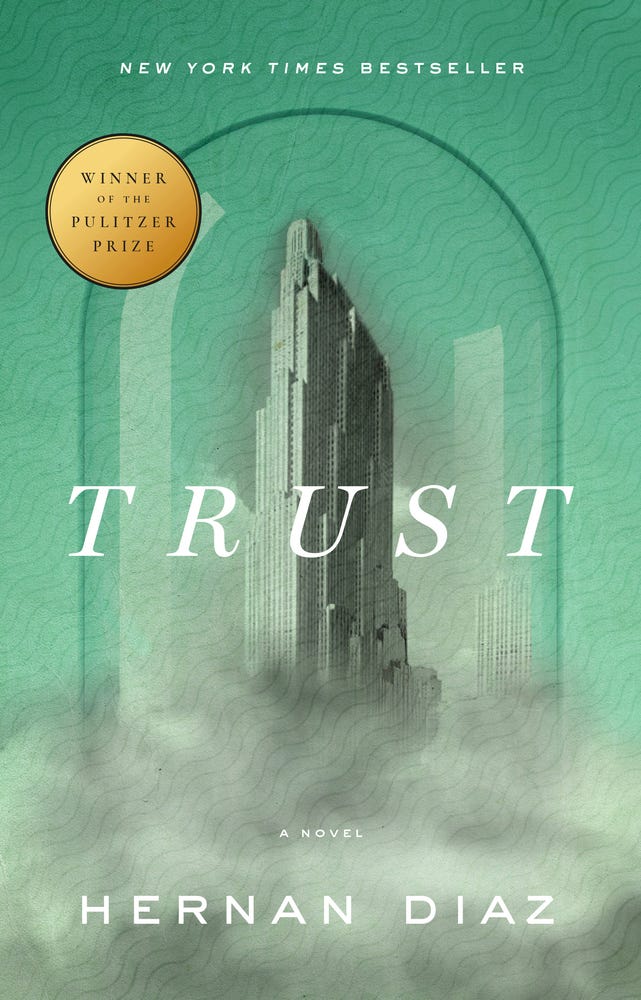
Although I felt that the book only truly hit its stride in the second half, I loved it. I particularly enjoyed how it explored themes of power and truth with competing narratives. That in itself is interesting, but that it also focuses on markets/finance adds another layer to how we truly build “trust” in society when we all contribute “individually” to a collective narrative (the market). Definitely up my alley as someone interested in finance and storytelling.
🕹 Gaming
Factorio: Space Age
See above. 😅
🏃 Running
Ran a half-marathon earlier this month. Did not train nearly as much as I wanted to due to summer holiday malaise in South Africa over Dec/Jan and then snowcrete in DC. So, I took it easy and it paid off, running my first negative split half-marathon. The second half of the race was downhill and I flew down it. One change I did in this race was 1) run without water on me in a half and 2) sizing up my shoes (because I kept getting blue toenails on longer distances). Both worked perfectly. So pretty happy.
Big shout-out to the people who came to support me. You know who you are!
🎶 Listening
Harry Styles - Aperture
With every new Harry Styles album there’s one or two songs that are absolute pop earworms for me. Aperture is the new album’s one. Such a great track.
Also. Love the dancing/choreography in this!
Muse - Be With You
Muse was my coming-of-age band. As a teenager, it was the band that truly opened my eyes to music. Over the years, I don’t connect as much to their subsequent music, but every so often, a new track comes out from them that I really resonate with. Be With You is one of those. The breakdown at the end is lovely.
ford. - Music Lights Color
So glad I discovered ford. Beautiful, world expanding music. Feels like a mixture of Tourist and Washed Out. Both have some dance sensibility while also being grounded in elements of rock/shoegaze. My favourite track is from ~12:00 in this full EP music video. Last track is also excellent. This is what sunsets feel like.
That’s it for this month, friends.
Hope you get to enjoy a lovely sunset. Stay illegible.
Simon
Like what I write? Please consider becoming a patron below ($5/month):
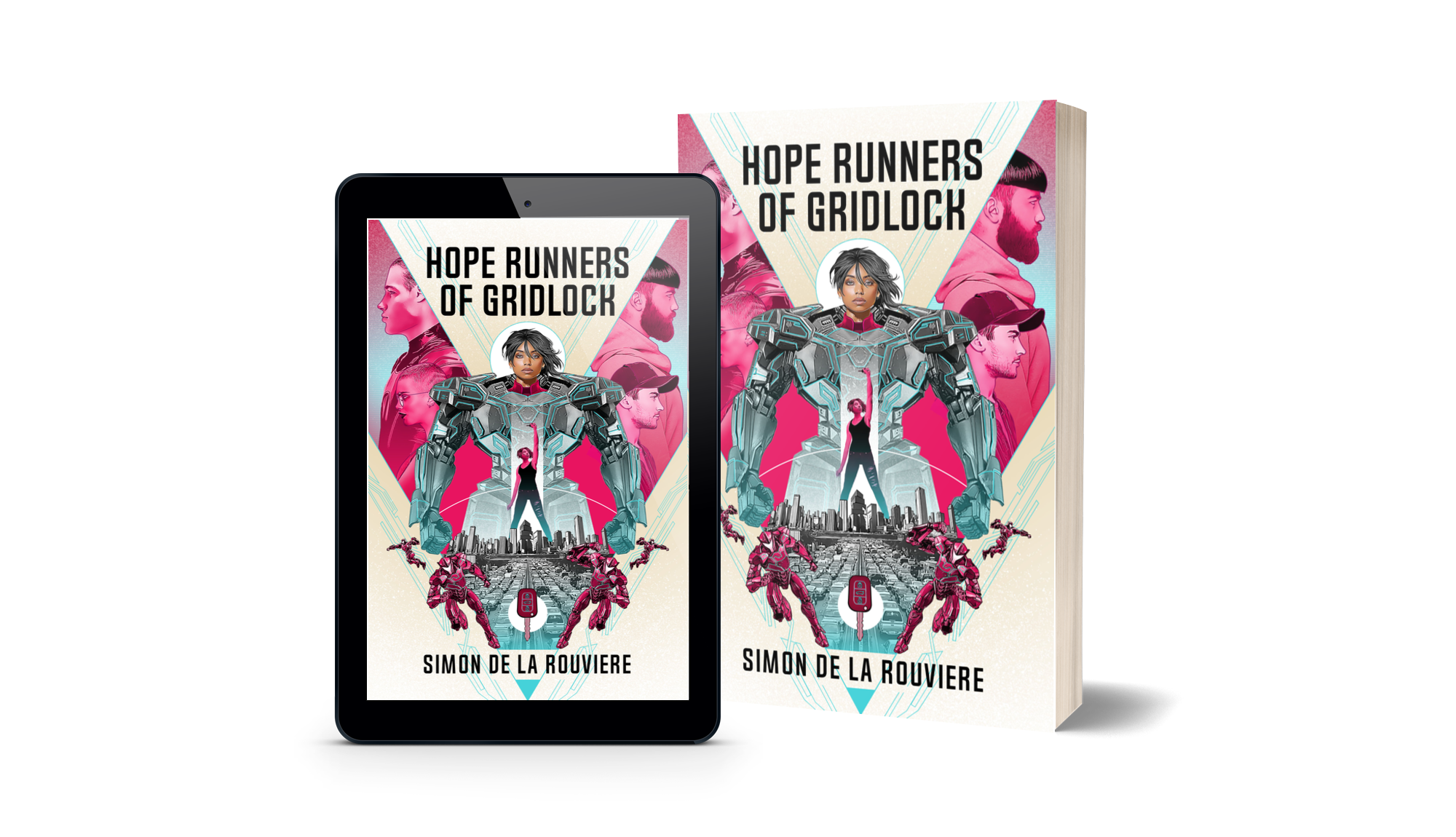
OR: Buy a copy of my self-published debut novel and leave a review!
Huge, huge fan of this month's newsletter!
"Using LLMs to go explore, to test and prod at latent spaces and to arrive back in our reality with newfound insight for the world isn’t slop." <3
Also loved Trust so much, and going to read that Harry x Murakami piece. You always expand the ways I'm thinking :)
You and I are now friends. This piece is definitely speaking *for* me inasmuch as it's a great point of third-party reference to support arguments I make all the time. So thanks, and let's rap.
https://michaelgarfield.substack.com/p/noisy