Welcome to Scenes With Simon. A monthly newsletter about many things. This month is about writing my second novel!
In the past 3 years, I’ve been working on and off on my second novel. I plan to start querying for an agent again in August. It’s been a far longer journey than I anticipated. I’ve got many thoughts to share: from lessons learned, why traditional publishing, AI+writing, and what the book is actually about! Let’s dig in.
Background:
In Feb 2019, a seed was planted.
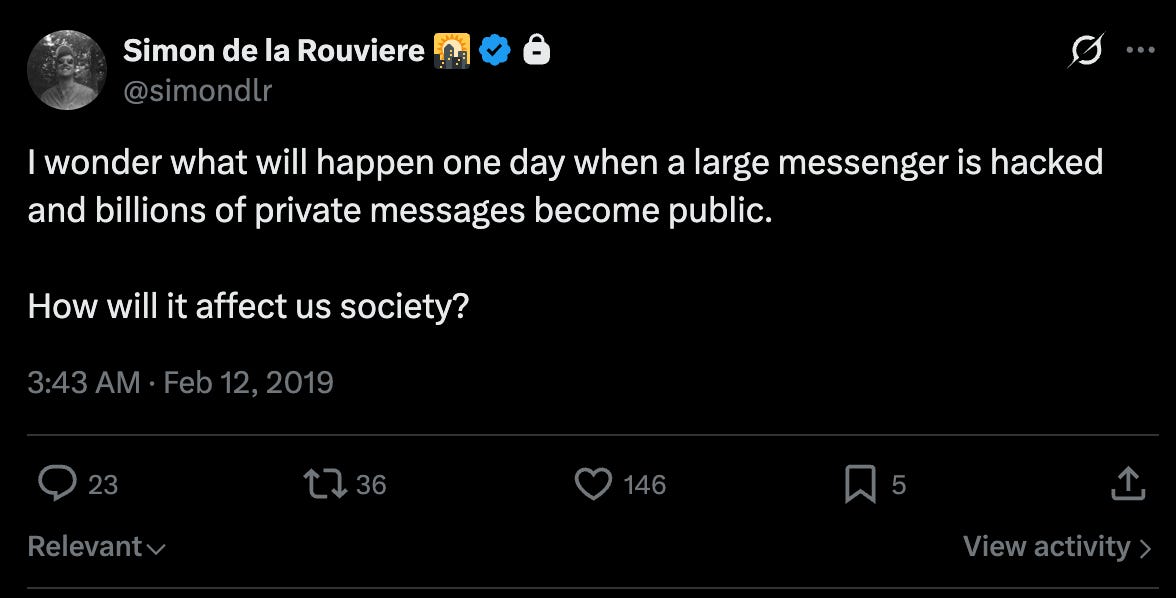
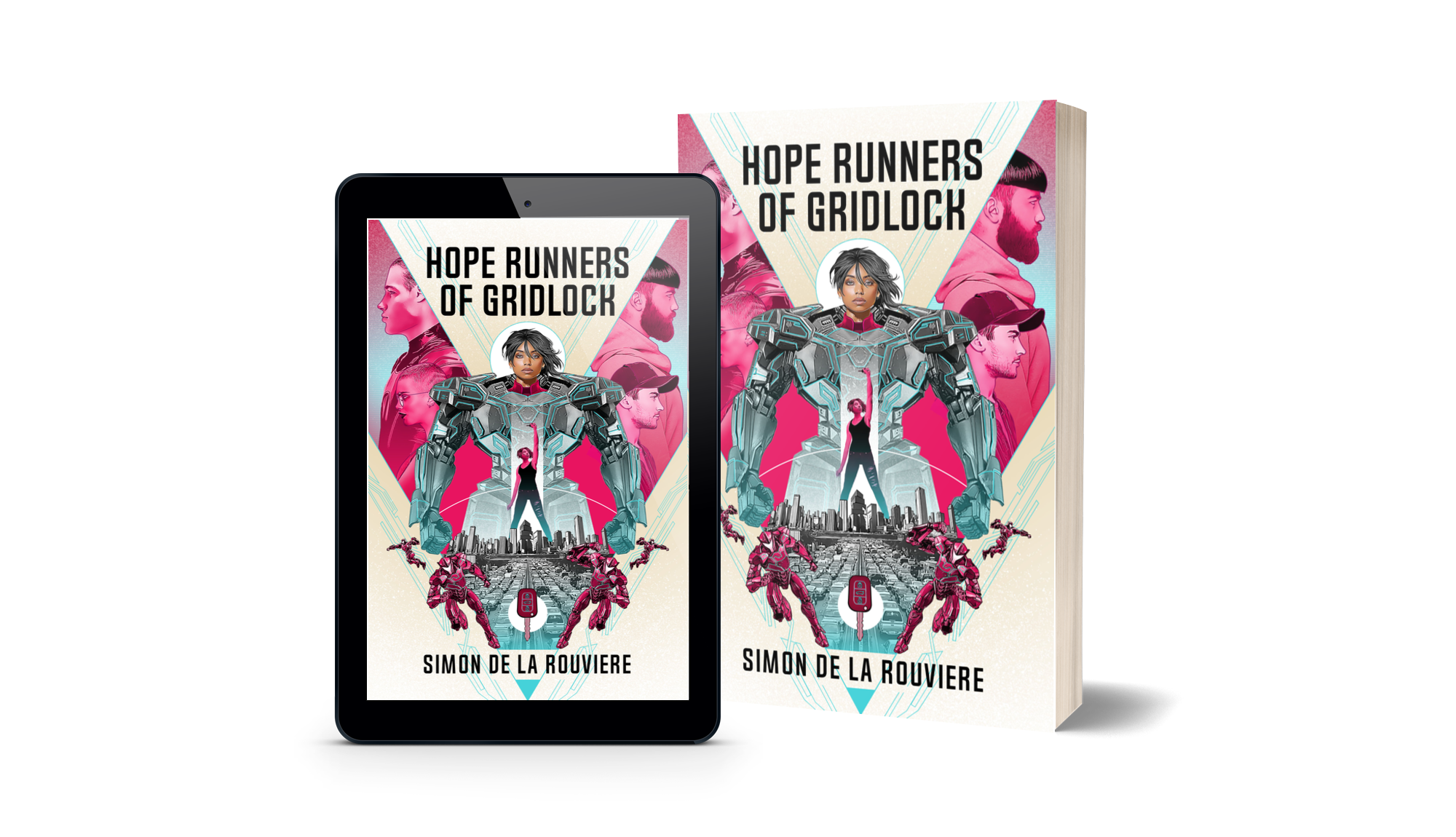
Since then, like with my previous novel, I couldn’t let the idea go. After struggling to write a sequel to Hope Runners of Gridlock that I liked (2 failed drafts), I wrote a short story in May 2022 based on the premise above in a world where memory loss pills also exist. It was fun and the story was well received: Serendipity of Self (free to read!)
After working on producing various sci-fi shorts through Untitled Frontier (selling NFTs as merch), I wanted to focus my craft. There were many moving parts to the Logged Universe shorts I produced and success, mostly hinged, on first improving my skill as a writer/storyteller before getting to combining unique parts again (eg, getting back into NFTs).
So, I picked up the story idea again above for two reasons: 1) I liked the speculative world of it and themes/questions it posed and 2) it was a bit more contemporary and thus more of a fit for traditional publishing. I’ll get more into that later.
In June 2023 I started writing. 3 years and 405 days of active writing days later, I’m polishing the final parts of the book with the aim of starting to query again.
Say hello to book #2 with the following working title and log line:
For Emily, From Serenity
After everyone’s private messages is leaked, Emily gets an unexpected opportunity through her husband’s revealed affair to discover the truth about her mother’s death.
In broader strokes, through Emily’s journey, she has to question how far she’s willing to go against her own sense of justice, forgiveness, and consent to pursue her truth. I want readers at the end to place themselves on this spectrum and ask themselves similar questions that the book evokes.
Questions like:
If this happened to everyone, would you read the leaked messages or not? Good or bad?
Would you be someone that’s willing to forgive and move on? What if some societies explicitly promote absolution through collective jubilees as a result of it?
Should we persecute people for things they said in private to others? Where’s the boundary between thoughts and action?
Is justice internal (personal belief that a wrong has been corrected) or external (it requires an audience)?
How much power are we willing to cede to tech companies?
Should we know everything? When is it best to simply, do nothing?
Timeline
Using Scrivener, I started writing in June 2023 and will finish with this revision in August 2026. The manuscript will end around ~70,0000 words. Here’s the timeline:
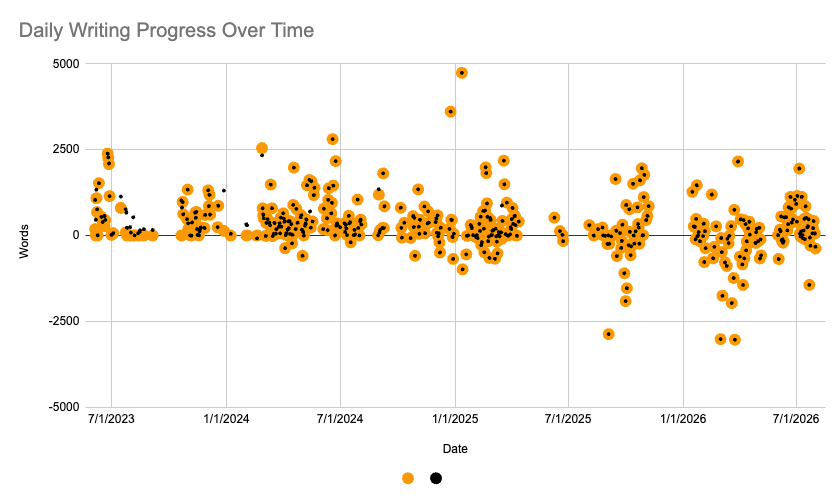
Orange dots = words written/removed on the manuscript.
Black dots = total words written (including additional materials such as research/notes/plotting/thoughts/etc)
Early on → more researching/planning/outlining.
Later on → strictly working on the manuscript itself.
There’s a few gaps here and there, but the rough timeline is:
June 2023: started writing.
June 2024: finished draft 1.
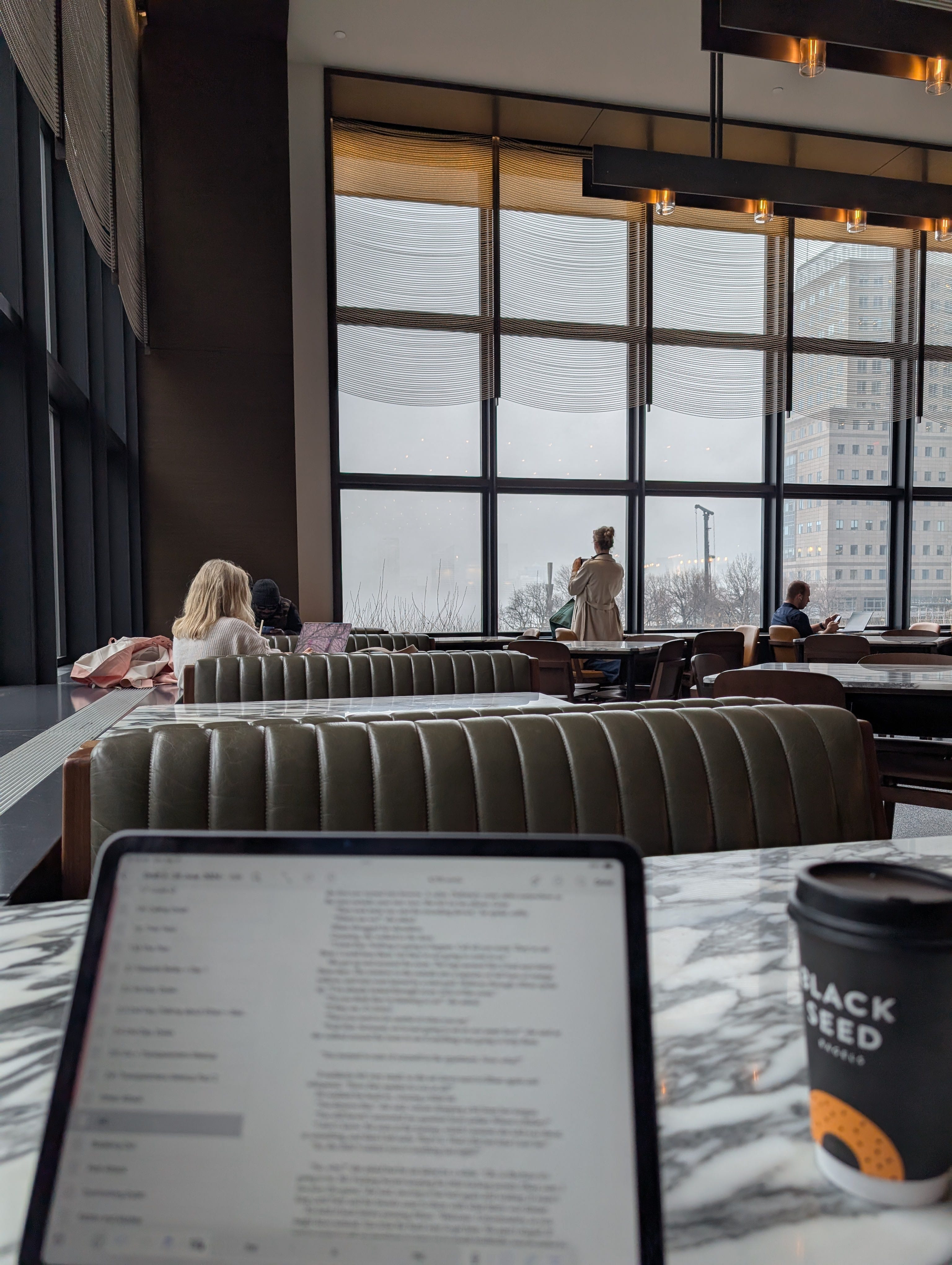
April 2025: finished with draft 2. Sent the book to beta readers. Then I went to walk the Camino.
For beta readers this time around, asking personal and industry friends to read and give feedback, I endeavoured to send them all as physical copies. It’s a huge ask for someone to read a novel, nevermind reading a work-in-progress version of the book. So, I wanted to not have it just be a digital copy. Something more personal and tangible.
I used Lulu.com to print and mailed them all across the world.
Here’s some test prints (earlier versions of the book were called “from veronica”).
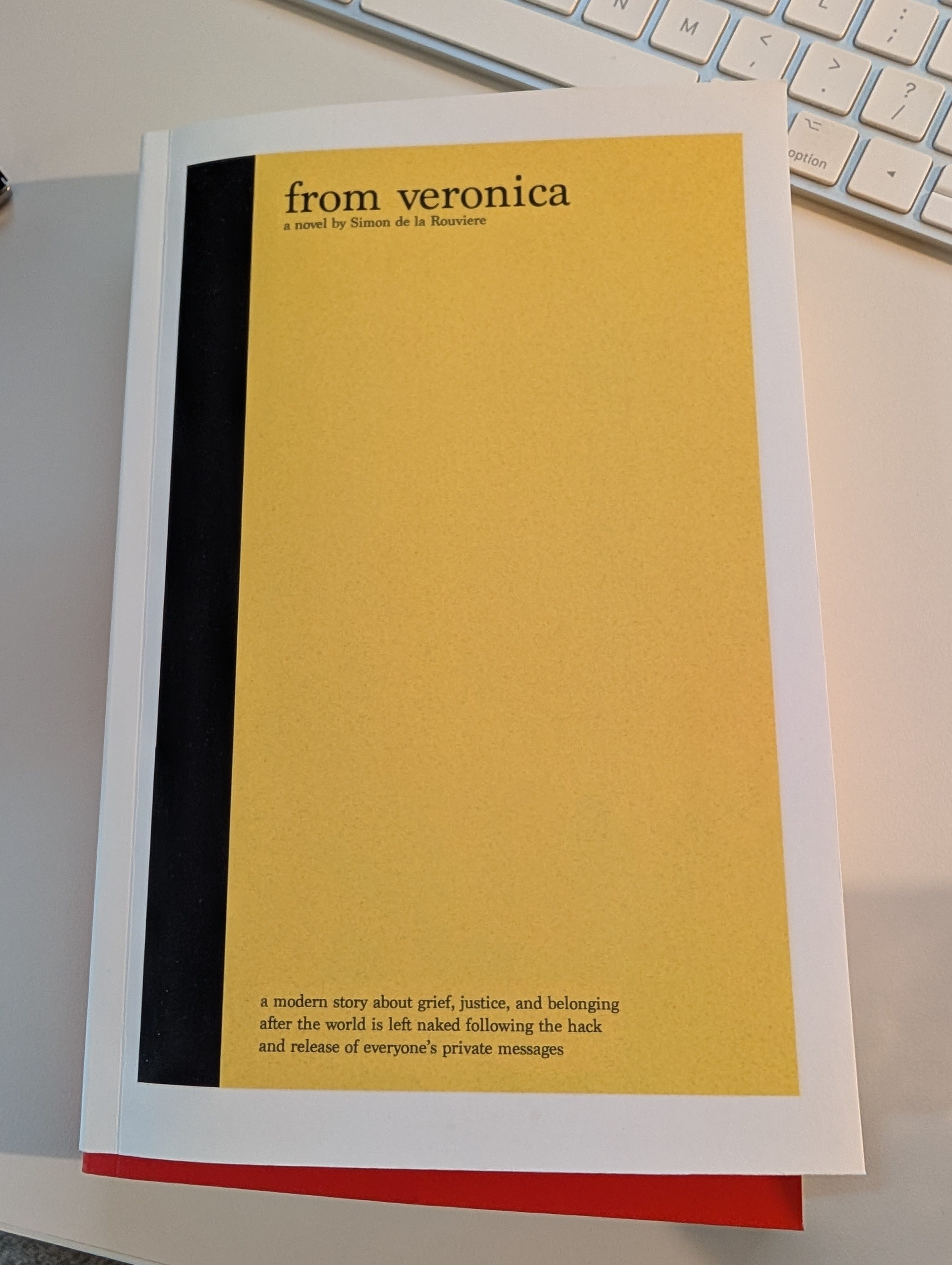
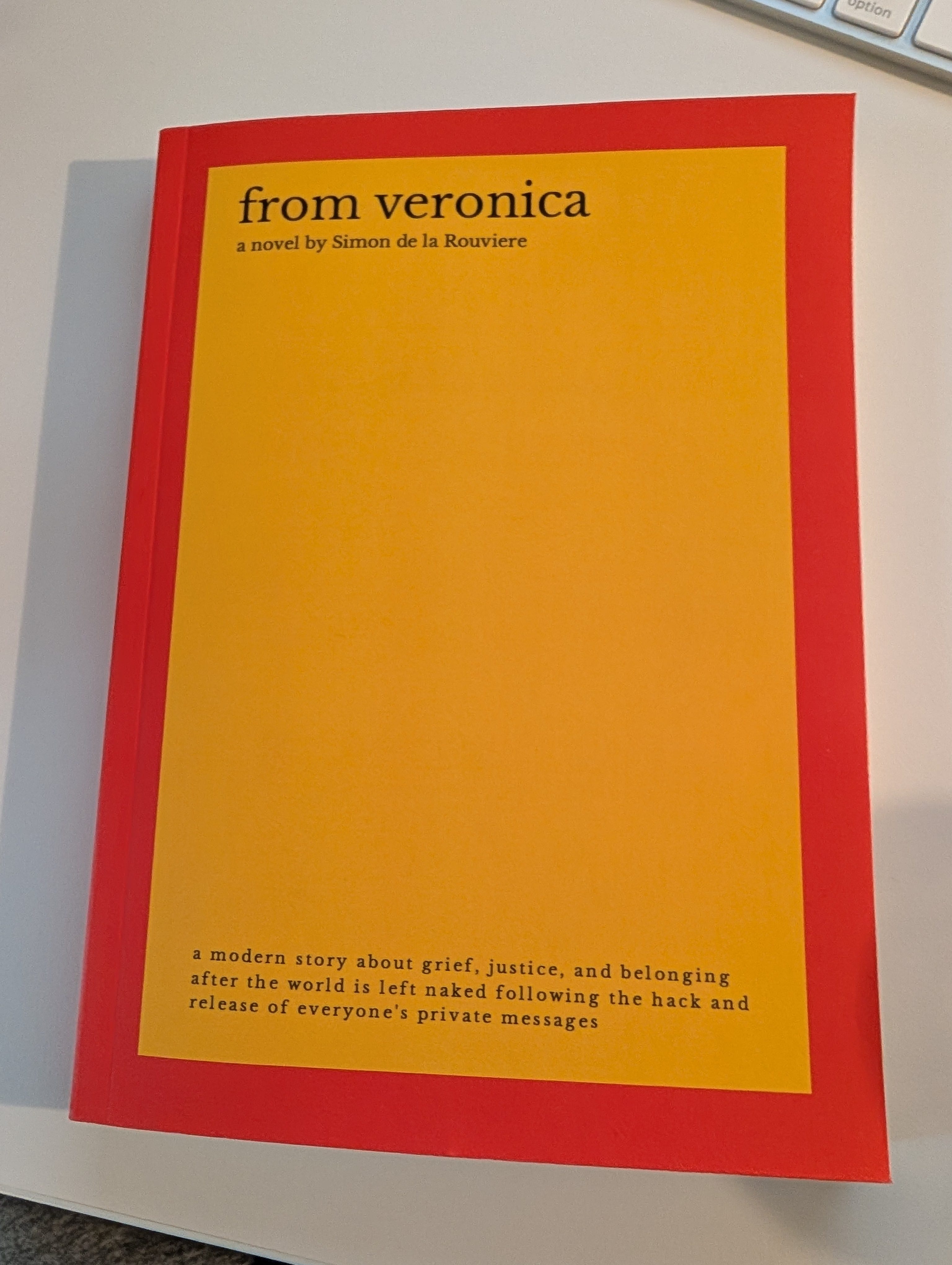
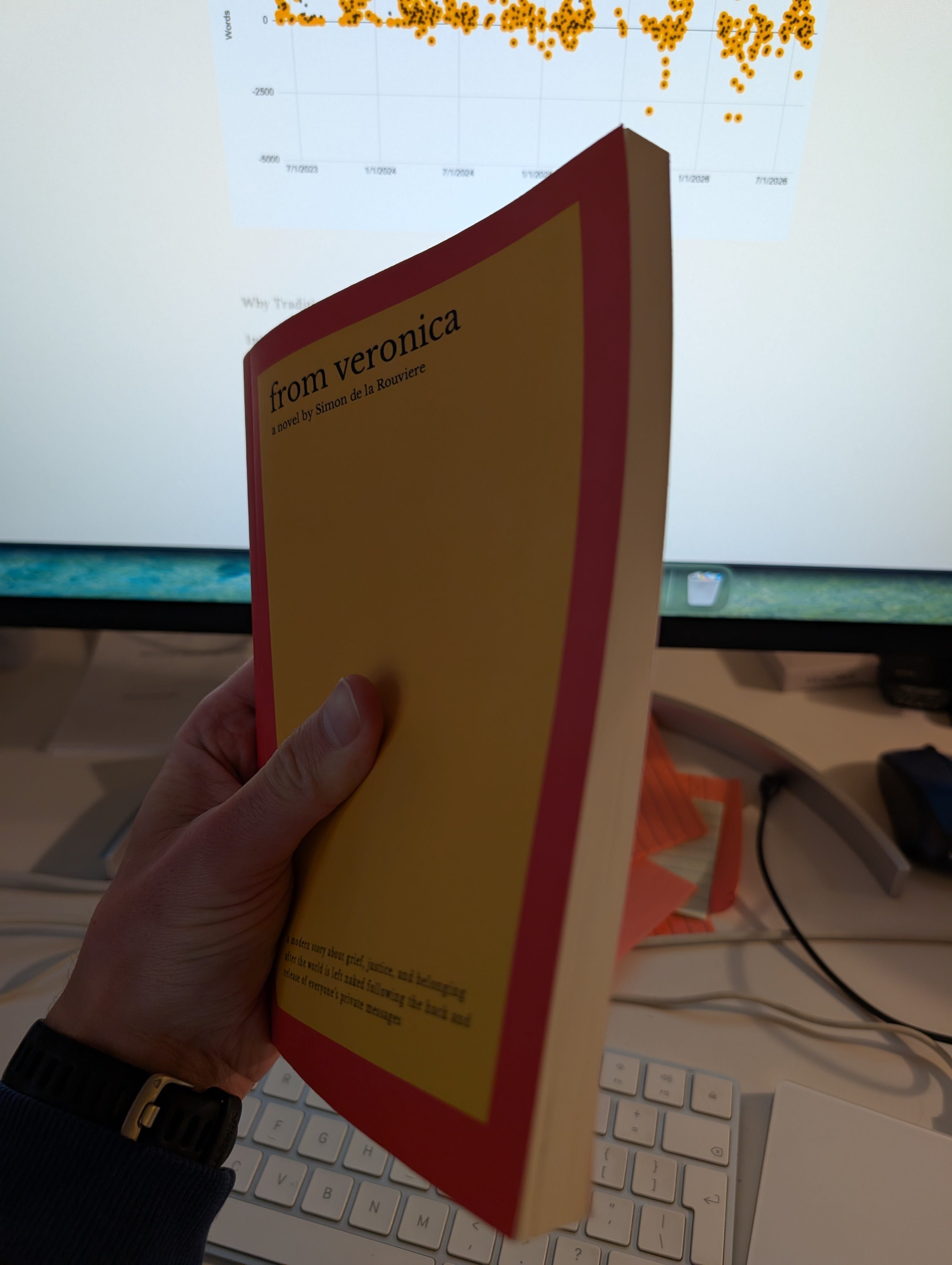
Thank you for those who read early versions of the story! You know who you are! :)
During last summer (2025), I also started sending out initial query letters to agents. About 8, using Publishers Marketplace, QueryTracker, and Manuscript Wishlist to find and query agents.
Agent feedback was either receiving no response, or form rejection (no personal feedback).
Reader feedback was very useful and good.
Two notable pieces of feedback were:
The protagonist often contorts herself to justify her actions.
The protagonist is unlikeable.
The first piece of feedback was a bit more straightforward. It was true. She had two competing motivations throughout the entire book and it was thus, just unnecessarily convoluted.
As a creator, it’s something I’ve encountered in almost every creative discipline. The hallmarks of an amateur is that when faced with new tools, the initial impetus is to make sure it’s used at all times. For example, if you play in a garage band with your buddies, you had likely just spent some hard-earned money buying an instrument. Of course you’re going to want to use it, and thus, every instrument is in every space in early songs. There’s no breathing room, no quietness, no negative space. The same for art: the initial belief that every part of the canvas need to be painted. In storytelling, it’s the same: the initial desire for complexity, richness, and detail.
In most creative disciplines, however, you first learn how to add things until you learn what you need to take away.
Writing book #2 was about learning how to start taking away.
So, that was useful feedback and it’s something that is good advice in general for storytellers. Start simpler than you think. Stay simpler than you think. Richness doesn’t come from adding more and more, but rather from knowing what to show and what not to.
The second piece of feedback was a bit more confusing. I don’t ascribe “unlikeable” as being morally questionable. Great villains can be very likeable and engaging. What that meant to me, is that the reader can’t get on the side of the protagonist for various reasons. I think a big part of this in general comes down to two things: agency and internal inconsistency.
For many stories, people enjoy characters that have agency. Don’t just make them victims. It’s why I wrote this article on the popular advice of “Save The Cat”.
A likeable character isn’t necessarily a morally good character (eg, “saving the cat”), but a character that has agency.
As for internal inconsistency: it’s fine to have a character go against the grain of who they are, but doing this without precedent, creates whiplash. It makes sense: in real life, we gravitate towards people with steadfastness and strong grounded values.
Revision 3
After feedback and querying, I started worked on the new revision. It was driven by the feedback above, but also another part of it. Most agents want anything up to the first 50 pages. Making that the best part of the book, was important, but given all the possible changes I wanted to do, I got to task in working on a much bigger revision.
At the end of this month (July), I finished about 95% of it and in the next two to three weeks, I’ll get to a point where I feel comfortable sending the book to agents again! I’m excited!
General Thoughts
While writing this novel, it was hard not to question the why of it. I love storytelling, and I love writing, but I often ask myself whether this is the highest leverage thing I could be doing with my time. In many ways, with the way the winds of media is blowing and the state of the world economy in general, writing a novel is a big risk. Not just financially, but, also creatively. Most writers I meet do this in their spare time or are independently funded otherwise (I’m lucky to mostly live off savings for now).
So, in some sense, it feels a bit insane to, in a world dominated by glowing boxes of algorithmic dopamine, to write a slow-burn story using only words. If you want to build a career from being a novelist, you likely have to commit to decades of this. Getting lucky is possible, but not something to gamble on. You have to really care about this discipline. I know where my wellspring comes from and it’s my insatiable curiosity.
But, the antithesis of it, is that writing novels provides a strong counterpoint of balance against what media feels like in general these days. One leg is steeped in the hypernormal algo-media world, the other in the slow time of writing ~300 words a day, growing and gardening a story to life.
I tend to feel unmoored if I don’t have a project to work on, something I’ve been trying to unlearn. Equally, I’ve been trying to unlearn that need to always be hyperleveraged on spending my time on the most optimal thing. I enjoy being a bit more illegible in my own way.
So, for now. I enjoy writing novels. I will continue write stories. But, I’m also looking forward to tackling some new projects in other domains again, too!
Why Traditional Publishing?
The primary reason is a desire to see the insides of the literature industry and to be judged by it. Traditional publishing is a big industry with many shapes to it. I’m not convinced that traditional publishing performs better with regards to access to distribution, but I hope to test that. I want to see what “the machine” of publishing can do in terms of putting this novel into the hands of people that might want to read it. There’s parts to it that feel outdated. For example, in querying you have to submit comparable titles (comps), the eventual goal of which is for an editor to run potential sales numbers on. It feels like it’s not enough to make a reasonable decision on. I’d love to see an actual study where comps are compared to actual, eventual sales. I’d be surprised if there’s actually a correlation at all. It would be fine if it was a sales/promo tactic to get an agent and get a publishing deal, but it is not. You kind of see this trend in tech/vc where decks have “x for y” language (eg, Airbnb for Pets). It helps to understand how the product is positioned, but a VC making reasonable bets on the numbers of such comparisons would be meaningless. Maybe I’m also overestimating the VC industry. 😅
So yes. It’s in part for me to judge the traditional publishing industry as much as it is about them, judging me.
Querying in itself has been fun to do. I’d recommend most authors to go through the process of writing it up after draft 1. If you’re struggling to do a query letter or write a one-page synopsis, you have to rethink the story for draft 2.
That being said. If I don’t land an agent, I’m definitely going to hire an editor and self-publish. I know that self-publishing is also not getting easier, but always be publishing is a mantra I’ve held for years. It will see the light of the day eventually.
Other Things I’ve Learned
I published additional essays over the past 3 years on my perspectives on storytelling:
Timeless Stories as Novel Settings x Themes
Story Length is a Factor of Stakes
Act 2 is About Context, Not Conflict
Don’t Write Near Future Sci-Fi Novels
You live in persistent fear that the future you predict might come true. Don’t give yourself this stress. 😆
Let’s talk about AI + Writing
Finally, let’s (briefly) talk about AI + fiction. For my novel, I only used AI to do research (eg, understanding finer points about the legal system).
I did not use it to generate or edit or give feedback on any plot points or character dilemmas. I enjoyed being stuck in figuring out ways around difficult parts of the book.
I believe it comes back to an earlier point I made about the mastery of a craft. I’m not against using AI in media creation (in any part of the loop), but as a creative in many disciplines I’m deeply fascinated by the meta of creativity. If I’m asking an AI to generative craft for me, I want to be able to have my own guiding intuition on whether it works or not. When you are using AI with no principle to how you’re guiding it, it tends to act like an amateur: it wants to fill every space (see all the AI generated flyers these days → insane saturated slop). Which, when you think about LLMs, that’s how they work. Latent space of an LLM isn’t empty. Justis has this theory, that the common writing tropes from LLMs come from the fact that it gives it itself options in order to continue to produce the next likely token.
If LLMs computed sentence-by-sentence, they’d choose whatever sentence fit the best. But since they compute word-by-word, they’ll tend to choose whatever specific word fits with lots of plausible sentences. “Not” (or “isn’t” or whatever) is a very strong candidate. You’re never going to paint yourself into a corner saying “not” next, just like you’ll never get fired for choosing IBM.
And so, writing fiction with AI isn’t necessarily bad, but you run the risk of your writing reverting to the mean. Default LLM prose is very permissive and almost “afraid” of committing to any particular trajectory.
It takes considerable effort to guide an LLM away from the mean such that it is instead used to explore frontiers. If you’re an amateur you wouldn’t necessarily be able to tell whether it sampled well from latent space or not. That’s up to your judgement.
In that sense, using generative AI to learn the craft of storytelling is probably not a bad use of it. And amateurs will likely produce compelling works simply because the long tail of media is always much longer than you want it to be. But, learning how to take away means learning to increase your own intuition on the nature, value, and meaning of stories. The Human Medium is the Human Message after all. As long as you use AI to not become more average, but rather more extraordinary and uniquely you. And that will always take introspection and time.
In Conclusion
The book was an anchor to 3 unique years of my personal life, keeping me pre-occupied through very highs and lows. For that, I’m grateful that it was there. This book has been a great journey!
Are You An Agent?
I’m excited to eventually get this book into more hands! If you’re an agent and interested, please get in contact!
In the rest of the issue of Scenes With Simon, I leave you with some snippets from the web and what I’ve been up to otherwise! Enjoy!
Snippets From The Web
This is one of the most interesting projects in the blockchain space I’ve seen in a while. Online gacha’s has become quite popular recently. You pay to get a random collectible essentially, sometimes being able to draw a legendary card. Not that much different to opening collectible card game booster packs, but now it’s platform-ized. FWA adds a new dimension to gacha platforms: two sides to the market. Users can participate in earning revenue by submitting their own collectibles to the market. Smart!
Don’t Just Do Something, Stand There
Timber Stinson-Schroff is asking questions I’m also asking. When to not do something.
Since most of my career has been spent as an analyst, I was more alert to the risk of analysis paralysis than of getting caught in a reactive loop. But after doing more operations, project management and portfolio work, it’s become clear that I was safely on one side of an ETTO distribution, where I faced diminishing returns to thoroughness. Now I routinely land on the side where hyperefficiency is the likely failure mode. It’s often worthwhile for me to proverbially, if not literally, sit on my hands.
Swiss Apartments Plans
Speaking of last month’s detour into enfilades (and European apartments), found a great example o a Swiss apartment.


How A-Corps Became Law
Still enjoying the work that Yancey Strickler has done on A-Corps. Get the insight into how A Corps became law in Colorado!
Converger
I’ve been enjoying reading Kevin Bankston’s Converger, writing on AI + broader media landscape. Check it out!
Any Austin + World Design in Games
I love this niche. Maps/worlds in games and their esoteric liminal spaces have always fascinated me. I used to enjoy glitching through early World of Warcraft maps in order to walk around unused spaces. So, I’ve been going through much of Any Austin’s videos, dissecting how world design affects feel, tone, and immersion.
What I’ve Been Up To
Creating:
✍️ Writing
See above. ☝️😅
👨🏻💻 Coding
When Fable was included in subscription tiers with Claude, I had to give a bit of a spin. When it was cooking, I was writing. I enjoyed playing with it to create a daily mobile word game. The ease with which these tools have made it to create simple puzzle/word games have really reinvigorated my desire to get back more into game design. Hoping to publish more of this, in time.
🖼️ Art
Pretty cool to see the Taschen book that my work is featured in has been entered into the collections of some stellar art museums. On NFTs added to museum collections!
Consuming:
📚 Reading
I’ve been trying to find more recent novels that I can compare to in my query letters. Sara Sligar’s Vantage Point has been a good one.
Vantage Point by Sara Sligar
A compelling story about trust and the stories we tell as it relates to technology and grief. These are strong pillars of my own novel, so I’m definitely going to use this as a comp title.
📺 Watching
Ballad of Wallis Island
A sweet film about lost love and nostalgia wherein a man tries to reunite his favourite band with earnings from a lottery.
Odyssey
Not much to add to the discourse, but I loved it. I enjoyed that it brought in more Bronze Age and Sea People’s lore. I went on a binge of reading about a few years ago and it sent back into the YouTube history rabbit holes. Such a fascinating time in history!
Sheep Detectives
Great, goofy, murder mystery movie with a lot of heart as a flock of sheep try to help solve the murder of their shepherd. While the heartfelt endearing nature of it caused some tears to fall, I was surprised at how much it tackled concepts of grief and memory. I would’ve loved a bit more compelling murder mystery though. :)
🏃 Running
It’s been so hot and humid. Never mind also having wildfires blow over from Canada. Been a big bust for running in July. But, I committed anyway to only do maintenance running this summer (for fun and health). It’s been nice to take a bit of a break.
🎶 Listening
Beirut - Ghost Train
Slow Joy - Forget
Been dabbling more recently midwest emo. Must be the American water rubbing off on me.
Humble the Great - find your own
Took me a while to finally get into the rest of Humble the Great’s 2024 album, but it’s been so great. Been on repeat.
That’s it for the July newsletter, friends! Thank you for reading. As always.
See you again soon. Hope you get to enjoy a lovely sunset!
Simon
Like what I write? Please consider becoming a patron below ($5/month):
OR: Buy a copy of my self-published debut novel and leave a review!